

What Texas homeowner policies say about foundations
Pull out the declarations page before you read anything else. Near the top it names your policy form. Further down, in the list of endorsements, you may find one with "foundation" or "slab" in the title. Those two lines settle most foundation claims before an adjuster ever drives out.
Texas used to write nearly every house on forms the state set, called HO-A and HO-B. Since 2003 insurers can file their own, and most now follow the national HO-3 pattern.
| Policy form | What it says about foundations | Where a leak fits |
|---|---|---|
| HO-3 style (most policies today) | Excludes settling, shrinking, bulging or expansion of foundations, floors and walls, and the cracks that come with it. | Covers sudden water damage in the house. Foundation damage from the leak needs the endorsement below. |
| HO-B (older Texas form) | Also excludes settling and earth movement. | The Texas Supreme Court held in 1998 that this form covered foundation damage from an underground plumbing leak. |
| HO-A (named perils) | Covers only the events listed in the policy. | If a water leak isn't on the list, it isn't covered. Read the list. |
| Foundation Coverage endorsement | Covers settling, cracking or heaving of the slab or footings when a leak from plumbing, heating, air conditioning or a fire sprinkler system caused it. | Pays to tear out and reach the leaking line. Usually capped at 15% of your dwelling coverage. The pipe itself isn't covered. |
Sources: Texas Department of Insurance consumer guides and Commissioner's Order 02-0741; TDI Bulletin B-0062-98 on Balandran v. Safeco. Wording differs between insurers, so your own policy controls.
The state insurance department's consumer guide reads the same way. Most policies won't pay for earth movement or a continuous leak, all-risk policies usually don't pay to repair a foundation, and a sudden, accidental release of water is the part that's typically covered. The same guide lists foundation and slab coverage among the add-ons worth asking your agent about.
When a plumbing leak turns foundation damage into a claim
Water leaking under a slab does one of two things to our clay. Sometimes it soaks in, the clay swells, and that part of the slab rises into a hump, usually around a bathroom or the kitchen where the lines run. Other times it runs, carrying fine soil off with it until the slab has a soft spot to sink into. In both cases the house moved because of the leak and not the weather. A policy with foundation coverage is written for exactly that story.
Adjusters want three things to line up:
- A leak somebody found and fixed. A leak detection report or plumber's invoice that names the line, the spot and the date.
- Damage sitting over the leak. A high spot or fresh cracks near that line, not a corner that's been dropping for years.
- Timing that fits. Doors that started sticking after the water bill jumped, not the summer before.
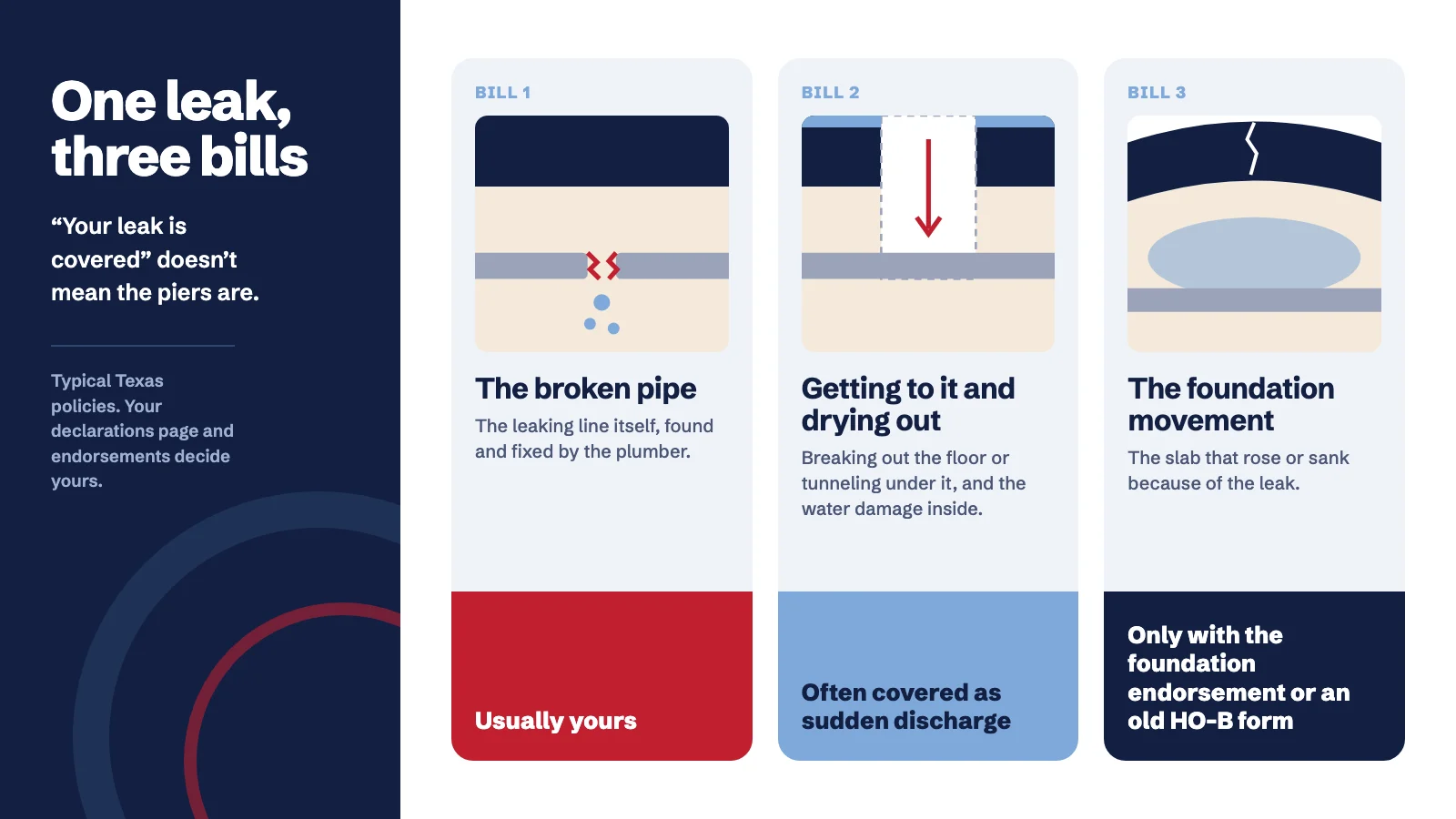
Think of one leak claim as three separate bills. The broken pipe is usually yours. Getting to it, by breaking out the floor or tunneling under it, and drying out the water damage inside are often covered as sudden discharge. The foundation movement is the third bill, paid only if you carry the foundation endorsement or still have an old HO-B form. Plenty of people hear "your leak is covered" on the phone and assume the piers are too.
No piece of evidence beats a set of floor readings from before the leak to hold next to a set taken after. Almost nobody has one. Keep the readings from any inspection you ever get, even the visit that found nothing wrong. A dated baseline is worth more in a claim than a shoebox of photos.
Settling, drought and tree roots stay outside the policy
Most movement in Smith and Gregg counties comes from the ground drying and wetting with the seasons. Upland lots here have a sandy surface over clay that shrinks and swells a moderate amount, and the floodplain clays near the Sabine move a good deal more. A corner that dropped after a dry summer is settling, however bad the cracks look. That's simply how East Texas soil behaves, and the policies are written around it.
- Drought. Summer 2011 was the hottest since 1895 in both counties. Houses that moved that year moved under the exclusion.
- Tree roots. An oak drinking from under one side of the house is earth movement in an insurer's eyes.
- Drainage. Downspouts dumping at the slab and yards that slope toward the brick count as maintenance.
- How it was built. Loose fill, thin footings, a slab poured out of level. Those go to the builder, if to anyone.
- Slow leaks. A drip that ran for months is continuous leakage, excluded on most policies even where a sudden burst would be covered.
When the readings point to plain settling, many homeowners hold off on filing. Under most policies that claim ends in a denial letter a few weeks later, and you still have a house to fix. Read your policy and talk to your agent before you file, and the state's homeowners insurance guide lays out the usual exclusions. Meanwhile, get the repair priced, and what foundation repair costs here will tell you whether the quote you get is in range.
The first week after you suspect a slab leak
Leak claims are mostly won or lost before the adjuster shows up, and some of the obvious fixes erase the evidence.
Start at the water meter. Turn off every faucet, the ice maker and the sprinklers, then watch the little leak dial on the meter for a few minutes. If it creeps with everything shut off, water is going somewhere. That check only catches the supply side. A cracked drain line under the slab never spins the meter and never shows on the bill. It shows up as a sewer smell, a tub that drains slow, or a static test that won't hold.
- Call a leak detection company, not a general plumber. Finding leaks under concrete is all they do. A plumber's camera is built to find clogs.
- Shut the water off at the main if it's bad. Stopping further damage is your job under the policy.
- Photograph before anything changes. Cracks with a tape measure beside them, the meter, wet flooring, the gap at a door. Date every one.
- Report it. Call the claim line and write down the claim number and the name of whoever you talked to.
- Fix the leak, then stop. Get the water off. No leveling and no patching floors until the adjuster has seen the damage.
That last step is the one people get wrong. A contractor can set piers while a claim is open, but the lift waits. Any decent crew runs a static test before leveling anyway: they plug the drain at the cleanout, fill the lines with water and watch the level, usually for about 20 minutes. When the level drops, there's a leak under the slab, and that result belongs in your claim file. What to expect during foundation repair walks through the test and the days around it.
Filing a foundation claim and pushing back
Report it promptly. The insurance department warns that some policies set a deadline as short as one year from the date of loss. After that the clock runs on the insurer: 15 days to acknowledge your claim, 15 business days to accept or deny it once it has everything it asked for, and five business days to send the check after it agrees to pay.
Build the file before anyone visits. It should hold the leak report and the plumber's invoice, water bills from a few months either side of the leak, your dated photos, and floor readings, along with any older set from when you bought the house. Be home for the adjuster and walk them to the leak spot first.
On a foundation claim, expect the insurer to bring in an engineer of its own. That engineer may be careful and honest and still works for the company paying the claim. A slab that heaved from a leak and one that moved with the seasons can look a lot alike, and the company's report tends to reach for the seasons. Your counterweight is a sealed report from an engineer you hired, one that ties the movement to the leak with readings. Do I need a structural engineer? covers when that report is worth its fee.
If they deny it, ask which clause the denial rests on and read that clause next to your declarations page. Know what each tool can do. Appraisal settles how much a covered loss is worth; it can't make an insurer pay for something it says is excluded. A coverage fight goes in writing to the Texas Department of Insurance through its complaint portal, or to a lawyer. The TDI Help Line at 800-252-3439 explains the process but can't decide your claim, and none of this is insurance advice. Your policy wording controls.
New homes and other ways the repair gets paid
For a house under about 10 years old, put the insurance policy down and find the builder's warranty booklet. Texas hasn't required a state new-home warranty since its residential construction commission was abolished in 2009, so any 10-year structural coverage comes from the builder's contract or a third-party plan. Most are sold as "1-2-10": a year on workmanship, two on systems, ten on major structural defects. Warranty companies measure your house against their own definition of a major defect, so read that page closely, have your own floor readings in hand, and send written notice before the deadline.
Older houses usually come out of pocket, and financing is common in this trade. When a leak claim does pay for part of the job, ask the specialist to write the leak-related work and the settling repair as separate lines. Then the insurer and the contractor are arguing about the same piers. You can see what goes into each part on the slab foundation repair page.
Get the cause on paper early
A fresh crack and a high water bill can mean a covered leak or plain old settling, and right now nobody knows which. The claim turns on that answer, and the evidence is freshest this week, before anything gets patched or leveled.
Pick up the phone and call (903) 522-4592. We'll set up a foundation inspection with a local specialist, who will read the floor in every room and check inside and out for signs of a leak. You keep the readings whichever way it turns out, and if the claim goes ahead they become the first page of your file.
 Prefer our guides in Google results
Sabine Valley Foundation Repair is paid by the independent foundation specialists it introduces homeowners to. That never changes the advice we give. How we're paid