
Five times an engineer pays for the visit
An evaluation costs real money, so it should earn its place. Any one of these five is enough.
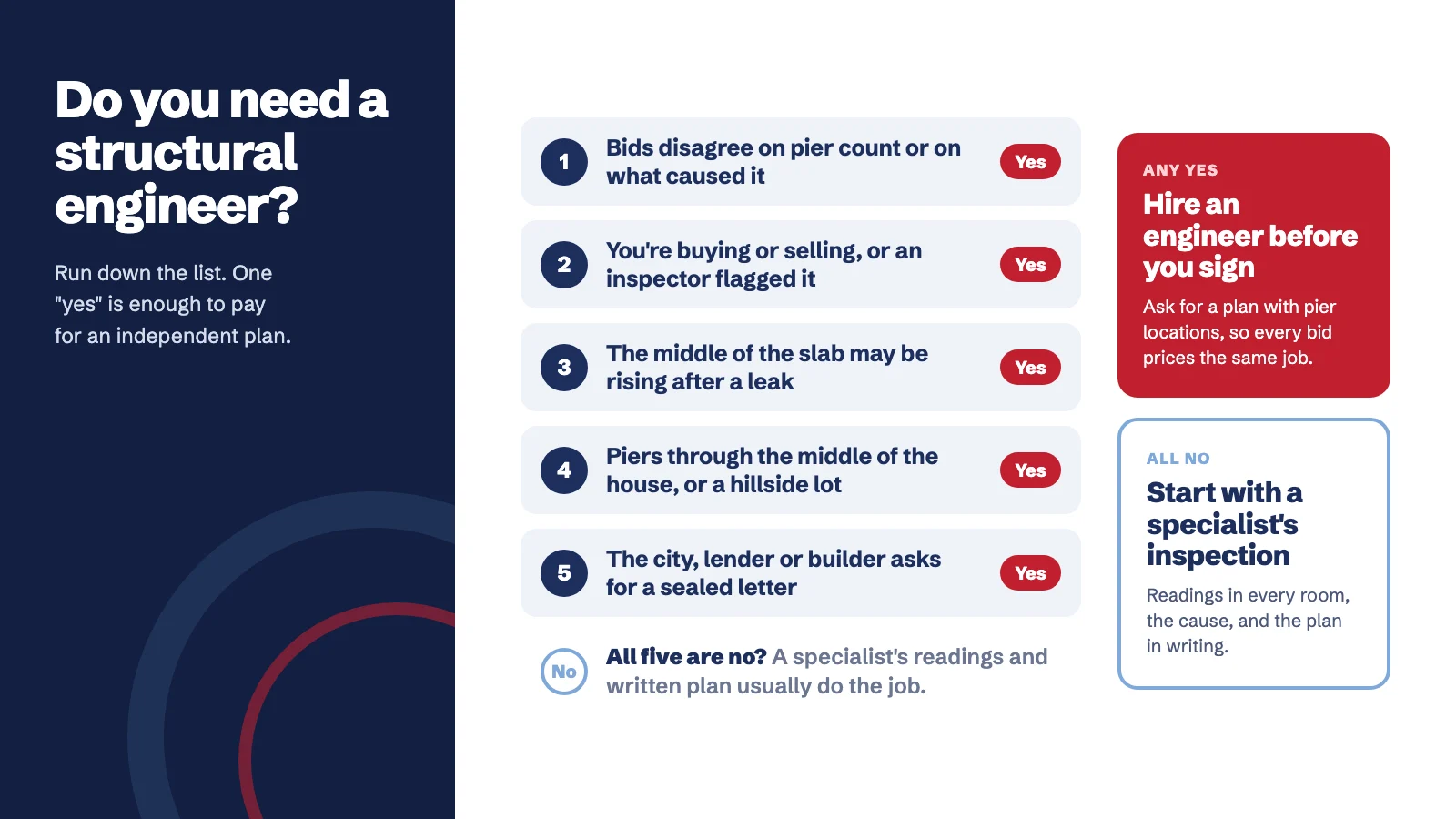
- The bids don't agree. Four piers on the back wall from one company, eighteen around the house from another. Somebody misread the house, and a plan from a person who sells nothing settles who.
- A sale hangs on it. Buyers' inspectors write slope down as a number. Then a sealed report saying the slope has been there since the slab was poured can hold a deal together over a house that never moved.
- Part of the slab may be heaving. Wet clay under a leak can lift the middle of a slab. Piers fix a house that went down, and telling up from down on one set of readings takes judgment.
- The job is big. Piers through the middle of the house, a hillside lot, an addition with no footing, a house on floodplain clay near the Sabine. A wrong plan costs more on every one of them.
- Somebody asks for it. A lender, a builder's warranty company or the city can want a sealed letter before or after the work.
Engineering fees vary with the house and how deep the investigation goes. Set them against what the repair itself costs here, the other side of that sum.
What you're actually paying an engineer for
Texas engineers wrote their own guideline for evaluating and repairing house foundations, through the Texas Section of the American Society of Civil Engineers. It splits an evaluation into three levels, and knowing which one you've booked saves a lot of disappointment.
- Level A, first impressions. The engineer talks with you, reads whatever paperwork exists, walks the house and gives an opinion, sometimes in a short letter. Fine for "should I worry?" Too thin to settle a fight over pier counts.
- Level B, readings and a drawing. Adds floor elevations across the house, plotted on a scaled drawing, with tilt and bending compared to accepted limits. This is the level that answers "did it move, and where?"
- Level C, testing. Adds whatever the case calls for: soil borings and lab tests, plumbing tests, a tree survey, photos and a detailed map of the cracks.
Check how a Level B drawing handled the floors. A reading on 3/4-inch hardwood next to one on sheet vinyl can show a dip of half an inch that isn't in the slab at all, and carpet and pad add more. Texas engineers' guideline asks them to say whether different floor thicknesses were accounted for and how slopes built into the slab were treated. If a report is silent on both, it may be measuring flooring.
For a repair, ask for plans as well as a report. It's common to pay for an engineer and get back a letter saying the foundation has moved and should be repaired by a qualified contractor. Three contractors then read that sentence three ways. A plan you can bid shows:
- Elevations on a drawing. Every reading written on a plan of the house.
- The cause in plain words. Settling, heave, or slope the house was built with.
- Each pier located. Type and depth criteria for every one, so each company prices the same piers.
- The water work. Whatever goes with it: a gutter, a regrade, a leak, a tree.
- How done is measured. A new elevation survey after the work, and the readings that count as finished.
What an engineer can tell you that a salesperson won't
Careful contractors and careful engineers often read a house the same way. What differs is what each one is free to conclude.
Readings, a likely cause, a plan and a price. The person in your living room works for the company that will do the job, and often earns more when the job is bigger.
Readings, the cause, and an opinion under their seal and license. Paid by you for the visit and the report, with nothing to install and no share of the repair.
Take a living room that reads 1 1/2 inches low along one wall. The engineer runs a tape from floor to ceiling at both ends and gets 96 inches on the high side, 97 1/2 on the low. A house that settles takes its ceiling down with the floor, so those framers built level walls on a slab that was already sloped. Outside, a 4-foot level on the brick shows the courses dead level. Two clues, one answer: it was built that way, and lifting it now would rack the framing and crack the brick on whichever side came up.
Independence also means an engineer can recommend no piers at all. The Texas guideline says an owner may reasonably choose periodic cosmetic repairs and door adjustments over underpinning, and that drainage, watering and monitoring can come before structural work or instead of it. Expect some caution before anyone tells you to cut down the oak, too. Take out a big tree that was there before the house, and the clay it kept dry can swell back and push the slab up. Trees and your foundation covers that trade-off.
When the answer is water, a good plan spells out the drainage work piece by piece. Downspouts go into solid pipe, for instance, because roof water dumped into a perforated French drain soaks the very ground beside the slab.
The guideline Texas engineers measure against
No law sets how far a house may move. Many Texas engineers measure slab foundations against a guideline from the Foundation Performance Association in Houston, FPA-SC-13-1, first issued in 2007 and revised in 2015. It gives two yardsticks.
- Tilt of 1% or less across the length, width or diagonal of the slab. Tilt is the whole slab leaning one way, and 1% works out to about an inch every 8 feet 4 inches. Around there, people start to feel it walking across a room.
- Deflection of L/360 or less. Deflection is the slab bending into a dip or a hump over a length, L. Across a 30-foot stretch, L/360 is 1 inch.
Both numbers are meant for an engineer working from a full elevation survey, and the guideline says outright that all foundations move. A salesperson with a level can't apply it as a pass-fail line, and it says nothing about pier and beam floor framing.
You may hear L/240 quoted as "the code." The building code does list L/360 and L/240, as limits on how much new floors, ceilings and framing may bend under load. Neither is a limit on foundation movement. How much foundation movement is too much has worked examples.
How to check a Texas engineer before you hire one
- Look up the license. Search the name or license number on the state engineering board's roster. The status should read Active, because only an active Texas PE may practice and seal reports here.
- Ask who is paying. State rules bar an engineer from taking pay from more than one party on the same project, and any conflict of interest has to be disclosed in writing. An engineer who arrived with the repair company may be perfectly sound; ask whether that company pays for this visit or sends them regular work.
- Ask which level you're getting. First impressions, a measured drawing, or testing on top. Ask whether a pier plan is part of the price.
- Ask about houses like yours. Residential work on clay is its own specialty. Someone who mostly designs commercial buildings may not be the right fit.
- Book the final visit now. The closing letter that confirms the job followed the plan only gets written if you hire the engineer for it. Ask what it costs and put it in the agreement.
The roster stopped listing addresses and phone numbers in 2023, so look for a firm's number on its own site. Neighbors who've been through a repair, local realtors and home inspectors are good for names. On an insurance claim, remember that the engineer the insurer sends writes for the insurer; how foundation claims work in Texas explains why your own report matters there.
When you can skip the engineer
Plenty of jobs in Smith and Gregg counties don't need one. Picture a 1990s brick ranch in Whitehouse. The back corner dropped after a dry summer, the downspout at that corner was dumping straight onto the slab, and the readings show one low area along one wall. Every bid puts a few piers along that wall and tells you to fix the gutter. An engineer's report would mostly confirm what three companies already agree on.
Routine pier and beam work is similar. Re-shimming, a few new block piers or steel posts under a soft spot, or a sistered joist are problems you can see for yourself from the crawl space.
Skipping the engineer doesn't mean skipping the checks. Get the readings on paper, ask every company the same questions, and make sure the plan names a cause. The day a bid surprises you, or a second one doesn't match the first, is the day to call an engineer. You'll find the full set of questions in how to choose a foundation repair company.
Engineer and repair crew on the same job
The strongest setup is often both: an engineer's plan and a crew that builds it as drawn. Hand every bidder the same plan and ask them to price exactly what's drawn. Whoever seals the plan is the engineer of record, and changes go through them. Crews sometimes know something useful, like a pier spot that lands on the sewer line. A change like that is fine once it and the reason have gone to the engineer in writing, before anyone digs.
During the work, a good crew logs how deep each pier went and the pressure it reached. Ask for that log. Afterwards the engineer, or someone working under them, takes a fresh set of floor elevations. If you hired them for it, they write a letter saying the work generally matches the plan and noting anything that changed. Keep the plan, the pier log and the letter with the warranty, because they answer most of a buyer's questions before anyone asks.
Don't expect the new readings to be dead flat. The engineers' own guideline says a lift seldom leaves a foundation level, and chasing the last half inch is how brick gets cracked. After that, measure again every few years, or after a hard season like the 2011 drought or the February 2021 freeze, so you always know where the house stood last.
Sort out which kind of job you have
Most people reading this aren't sure yet whether they're holding an engineer job or a plain repair. One set of floor readings usually settles it. A single low corner with an obvious water source is a job to price. Movement in three directions, a hump in the middle or bids that fight each other is a job for an engineer first.
A short phone call is the quickest way to find out which pile you're in. Ring (903) 522-4592, describe the cracks and the bids, and we'll arrange a foundation inspection with a local specialist. If the readings say engineer, you'll walk into that hire knowing which level to ask for.
 Prefer our guides in Google results
Sabine Valley Foundation Repair is paid by the independent foundation specialists it introduces homeowners to. That never changes the advice we give. How we're paid