
A big tree works like a pump on one side of the house
Say there's a water oak about 20 feet off the back bedroom corner, planted when the house was new and now taller than the roof. Every hot day from May to October it pulls water out of the ground. It takes it wherever its roots run, and on most lots some of them run under your slab.
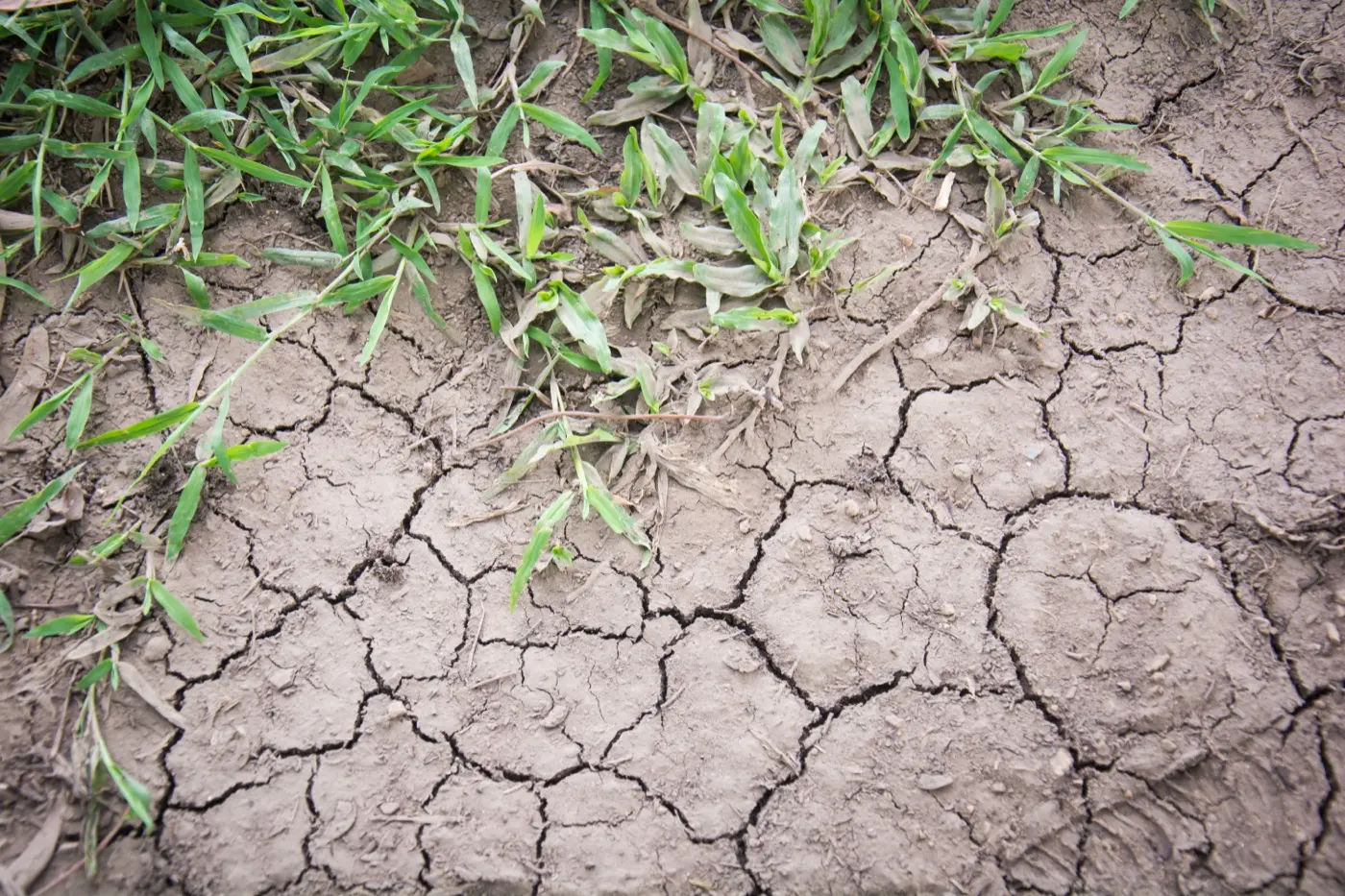
People picture roots shoving the concrete up like a crowbar. That almost never happens. Houses are heavy, and roots go where it's easy: along the top of the clay, under a sidewalk, into a cracked sewer line where there's water. The damage comes from the drinking. On the sandy loam over clay that most houses here sit on, the sandy layer hardly changes, but the clay underneath shrinks as the tree dries it, and the corner of the slab sitting on that clay drops a little.
Winter rain refills it, and some of the movement comes back. In a year like 2011, when Tyler went most of the summer without real rain and logged 81 days at 100°F or more, the oak kept drinking and nothing refilled the clay, so the drying went deeper and stayed longer. Drive one of the older tree-lined streets in a dry September and you can sometimes see it in the driveways and curbs as well as the brick, little dips under each big tree.
Make the tree prove it before you blame it
A tree near a cracked house is an easy suspect. Sometimes it's guilty. Often it's standing next to the real cause.
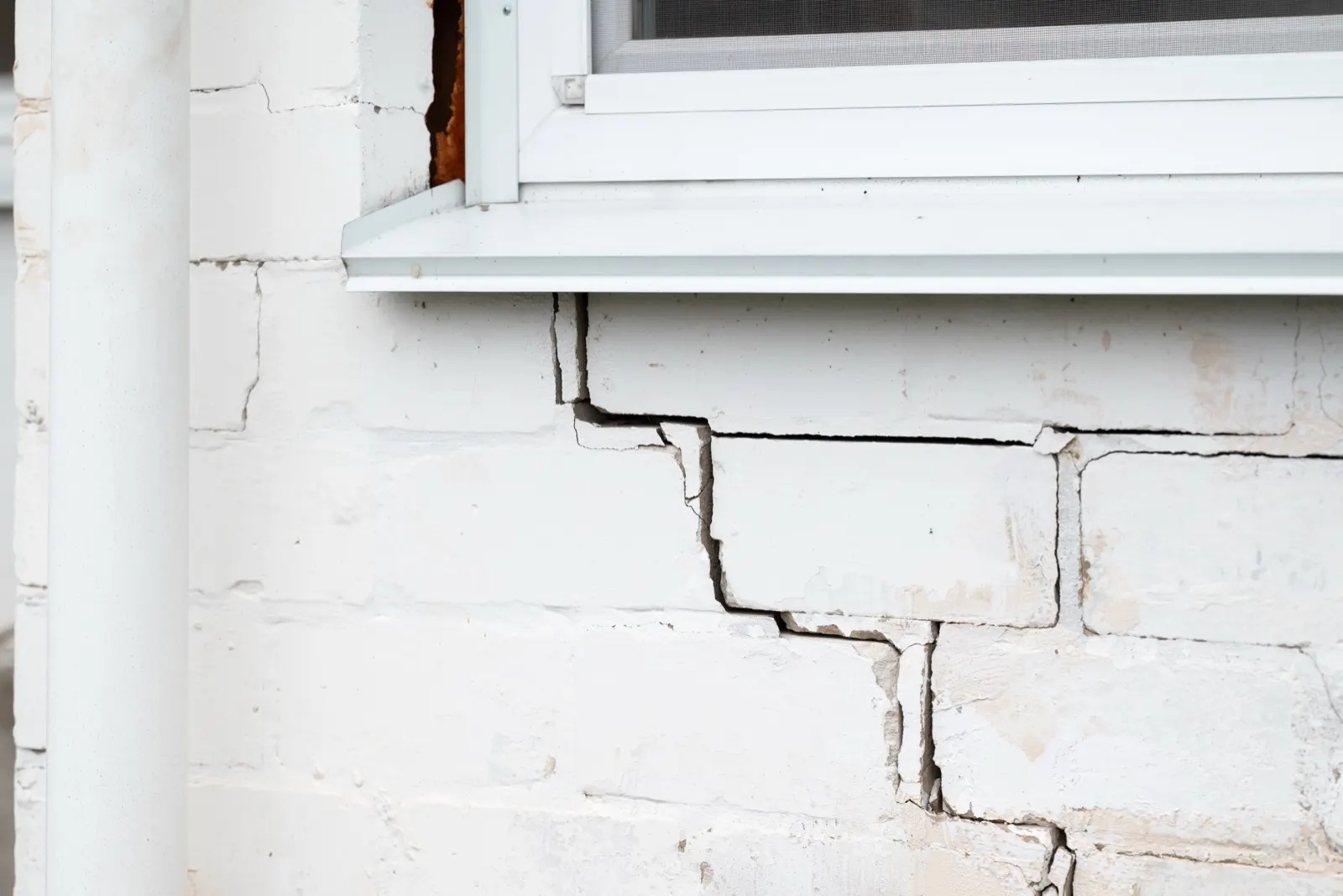
Start with the pattern. Tree damage shows up on the side facing the tree, and it comes and goes with the seasons. Stair-step cracks in the brick on that side, a door there that rubs by August and swings free by February, a wider gap between the soil and the slab on that side than anywhere else. If the floor readings slope down toward the tree, the case gets stronger.
Then test it yourself with a pencil. In early summer, mark both ends of a crack on the tree side with a short pencil line and the date. Do the same with a crack on the far side of the house. Mark them again in September and again after the winter rains. If the tree-side crack grew through the summer and closed up some by spring while the far one barely changed, that's the tree drying the clay. A crack that only grows, summer and winter, is pointing at something that isn't seasonal.
Now look for the other suspects on that same side. A downspout dumping there, a sprinkler hitting the brick, a dripping hose bib or a slab leak can make the same marks, and a dry-side problem and a wet-side problem need opposite fixes. The shape of each foundation crack usually tells you which one you have.
Tree people and foundation people will tell you different stories
Be ready for this. Ask a tree company and you'll likely hear that trees are seldom the whole cause, and that taking a big one out can do more harm than leaving it. Ask a foundation company and you may hear that the tree has to go or a barrier has to go in, ideally before the piers. Both have a point, and both sell the answer they're recommending.
They also answer different questions. An arborist, ideally a certified one, can tell you how healthy the tree is, how far its roots likely run, how much root loss it can stand and whether removal makes sense for the tree. What an arborist can't tell you is how far your slab moved.
A foundation specialist tells you about the house: which side is low, by how much, whether it's still moving, and what the yard and plumbing point to. They're not the right person to decide if an old oak can lose a third of its roots on one side.
For most homeowners the order is house first. A foundation inspection with floor readings tells you whether there's a problem worth acting on at all. If the readings point at the tree, bring in an arborist before anyone cuts a root or the trunk. The exception is a tree that looks sick, hollow or leans toward the roof. Call the arborist first on that one. A falling limb is a bigger worry than a slow slab.
Distance matters less than size, soil and water
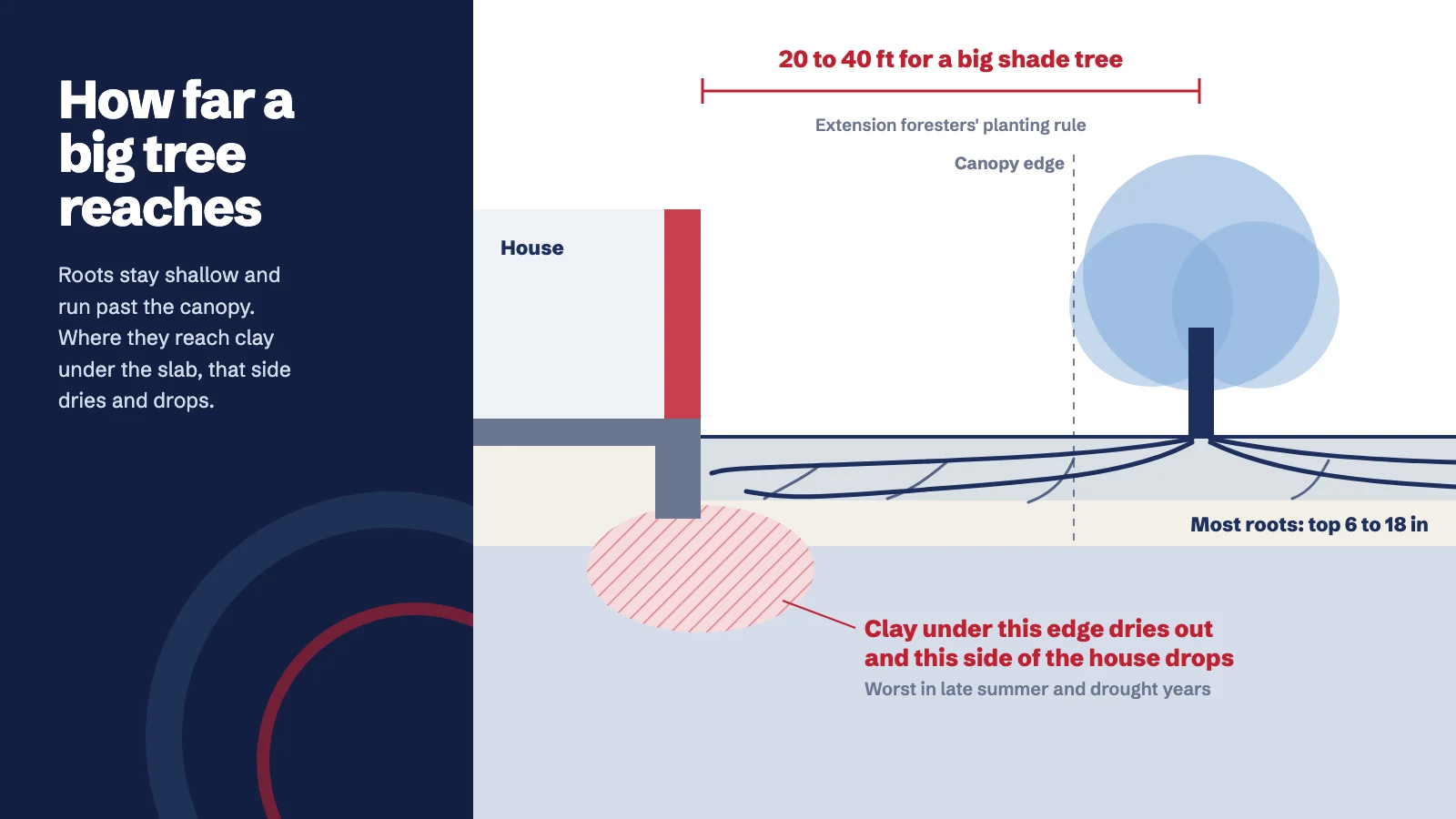
Roots go out much more than they go down. Iowa State University Extension puts most of the roots that take up water in the top 6 to 18 inches of soil, and says the bigger structural roots can run several times farther out than the drip line, the edge of the canopy. Other extension answers say a root system can spread two to five times the tree's height from the trunk. So branches that stop 15 feet from your wall tell you very little about where the roots stop.
For planting, Purdue's extension foresters give a simple rule: at least 20 feet from the house, and as far as 40 for a large shade tree. That's a rule about giving a tree room to grow. No US extension service publishes a safe distance for a foundation on East Texas clay, and nobody has ranked our local trees for how hard they pull on it, so be wary of anyone quoting one.
What decides it is the mix. A big oak 25 feet off a corner on Cuthbert clay can matter more than a crape myrtle 8 feet away. A pine on a deep sandy ridge may never move the house at all, because there's little clay there to shrink. Not sure which ground you're on? Your soil type is free to look up by address. Then judge the tree by what the house is doing, not by the tape measure.
Keeping a big tree and a level house
Plenty of houses here live next to big trees for fifty years without trouble. The ones that stay steady get water where the tree can use it and the house won't feel it.
In a long dry spell, water the tree out at its drip line, not at its trunk and not along your wall. Texas A&M AgriLife's drought advice is to put the water at the drip line, spread a few inches of mulch there, and water early or late in the day. A tree with water out there has less reason to hunt under the slab for it. Keep a slow, even soaker hose loop along the foundation on every side as well, so the tree side doesn't end up as the only wet or the only dry one.
Keep the rest of that side honest too. A gutter that overflows onto the tree side, or a bed that's been raised against the brick, muddies the picture and makes it harder to tell next summer whether the tree is still pulling.
How a root barrier goes in, and what it won't do
A root barrier is a sheet of tough plastic, usually solid polyethylene, set on edge in a narrow trench between the tree and the house. Contractors commonly take it about 36 inches deep. That depth isn't magic. It works because most of the drinking roots are in the top 18 inches, so a wall twice that deep turns nearly all of them. Roots that reach it grow along it or dive under, and the soil on the house side stays out of reach.
Done properly, the job runs like this:
- An arborist marks where the trench can run. The farther out toward the drip line, the better for the tree, and it shouldn't wrap halfway around the trunk. Leave a few feet between the barrier and the slab if the yard allows.
- Somebody phones 811 a few days ahead. Under Texas law that call goes in at least 48 hours and no more than 14 days before powered digging 16 inches or deeper, and it applies to a homeowner with a rented trencher as much as to a crew.
- Private lines that 811 doesn't mark, like the sewer lateral, sprinkler pipes and private gas or water lines, get found by hand. Near those, the trench is dug by hand too.
- The crew cuts the trench along the side facing the tree, cutting the roots that cross it cleanly rather than tearing them.
- The barrier goes in, the trench is backfilled and packed, and the top edge is left just at or above grade so roots can't hop over.
Afterward, the ground on the tree side keeps moving with the seasons. During a dry August you may see the soil drop on the tree side of the line while the house side stays up. That's the barrier doing its job. It won't lift a corner that has already dropped; it stops the tree from making it worse. When the house needs piers as well, the barrier usually goes in first, so the repair isn't fighting the tree from day one.
Cutting the tree down can push the house back up
Taking the tree out sounds like the clean answer, and sometimes it is. But clay that a big tree has kept dry for decades doesn't stay dry once the tree is gone. The rain that used to go into the tree goes into the soil, and the clay slowly swells back. Building guidance on clay soils calls this heave. How much depends on how big and thirsty the tree was and how tight the clay is, and it can take years to play out.
So a house that dropped toward the tree may rise again on that side after the stump is ground, and not evenly. The costly version is doing the jobs in the wrong order: the house gets slab repair with piers and is lifted level while the tree is standing, then the tree comes down a year later and the swelling clay pushes that side up past where the crew set it.
Removal still makes sense when the tree is dying, dangerous, leaning toward the house or has its roots in the sewer line. Do it with a plan:
- Get floor readings before the tree comes down, so there's a baseline.
- If leveling is also on the cards, tell the foundation specialist about the tree first so the jobs go in the right order.
- Have the stump hole filled, packed and sloped so rain runs away from the slab.
- Take readings again after a year to see what the ground has done.
Measure the house before anyone touches the tree
Whatever you end up doing about the tree, the cheapest mistake to avoid is guessing. A set of floor readings now gives you a baseline, shows whether the tree side really dropped, and tells the arborist and the foundation crew what they're working with.
Call (903) 522-4592, mention the tree, and we'll have a local specialist out to measure the floors before any saw or shovel comes out. If the phone's awkward right now, leave your number and we'll call you.
 Prefer our guides in Google results
Sabine Valley Foundation Repair is paid by the independent foundation specialists it introduces homeowners to. That never changes the advice we give. How we're paid