What a post hole on your lot will tell you
Anyone who has set a fence post on the hills around Tyler knows the first foot or so. It comes up tan and gritty and the shovel goes in easy. Then the color turns red or yellow-brown, the dirt starts sticking to the blade, and you're leaning on the handle. You've hit the clay.
That two-layer dirt is the most common ground in both counties. Soil scientists call it Cuthbert, and it covers roughly 15 percent of Smith County and 17 percent of Gregg, more than any other series in either one. It sits on the side slopes above creeks, often steep enough that the builder had to cut one end of the lot and fill the other to get a flat pad. Kirvin is the same idea on gentler ridgetops, with a subsoil that can run 35 to 60 percent clay. Plenty of the subdivisions on the Tyler side of the region are built on one or the other.
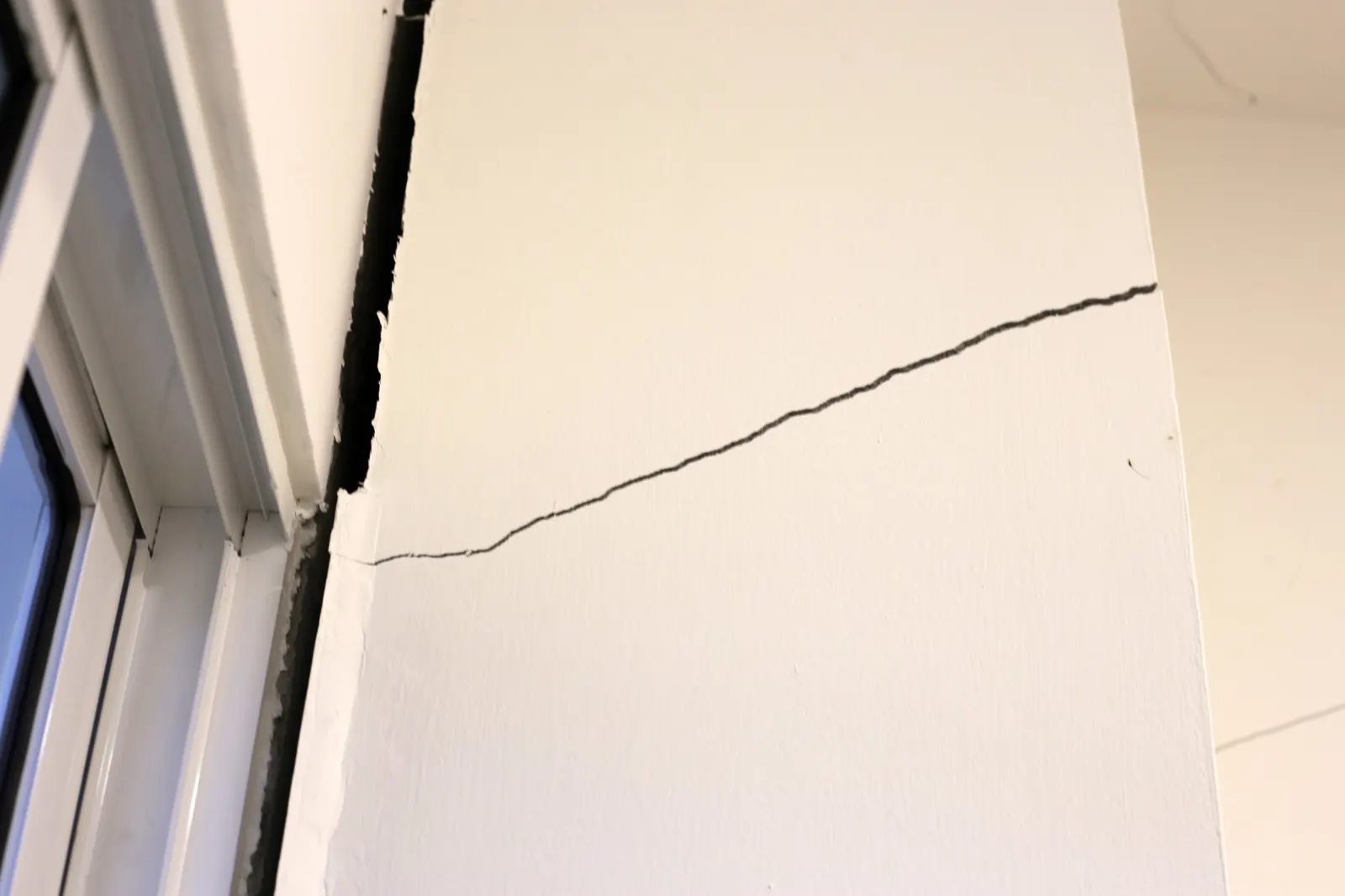
Both drain well. Both are rated moderate. In practice that means the clay moves enough to crack brick and stick a door when one side of a house dries out far faster than the other, but it won't heave a slab inches in one wet season.
The sandy cap changes how water travels. Rain sinks through the sand quickly and slows down when it reaches the clay, then spreads sideways along the top of it. A downspout dumping at one corner wets more than the bed you can see. It can feed water along that clay surface right in under the slab edge, which is why a single bad gutter shows up in the floors.
Moderate on the hills, very high in the bottoms
NRCS puts a number on shrink and swell called linear extensibility. Take a moist sample, dry it in an oven, and measure how much shorter it got. Under 3 percent is low. From 3 to 6 is moderate, 6 to 9 is high, and anything over 9 is very high. These are the soils you're most likely living on.
| Soil series | Where it sits | Profile | Shrink-swell (highest layer) |
|---|---|---|---|
| Cuthbert | Side slopes above drainages, both counties | Fine sandy loam over clay | Moderate, 3.3 to 4.5% |
| Kirvin | Gentle upland ridges | Very fine sandy loam over clay | Moderate, 4.5% |
| Bowie | Broad upland ridges | Sandy loam over loamy subsoil | Low, 1.5% |
| Wolfpen, Pickton, Lilbert | Upland ridges | Thick sand over loamy subsoil | Low, 1.2 to 1.7% |
| Estes | Creek and river floodplains, Gregg County | Clay and silty clay | High, 7.5% |
| Gladewater | Sabine River bottoms | Clay, 60 to 70% clay | Very high, 13.3% |
Read down the last column and the picture is plain. The sandy ridges are some of the steadiest building ground in the region. Gladewater, at the bottom of the table, can shrink about three times as much as Cuthbert.
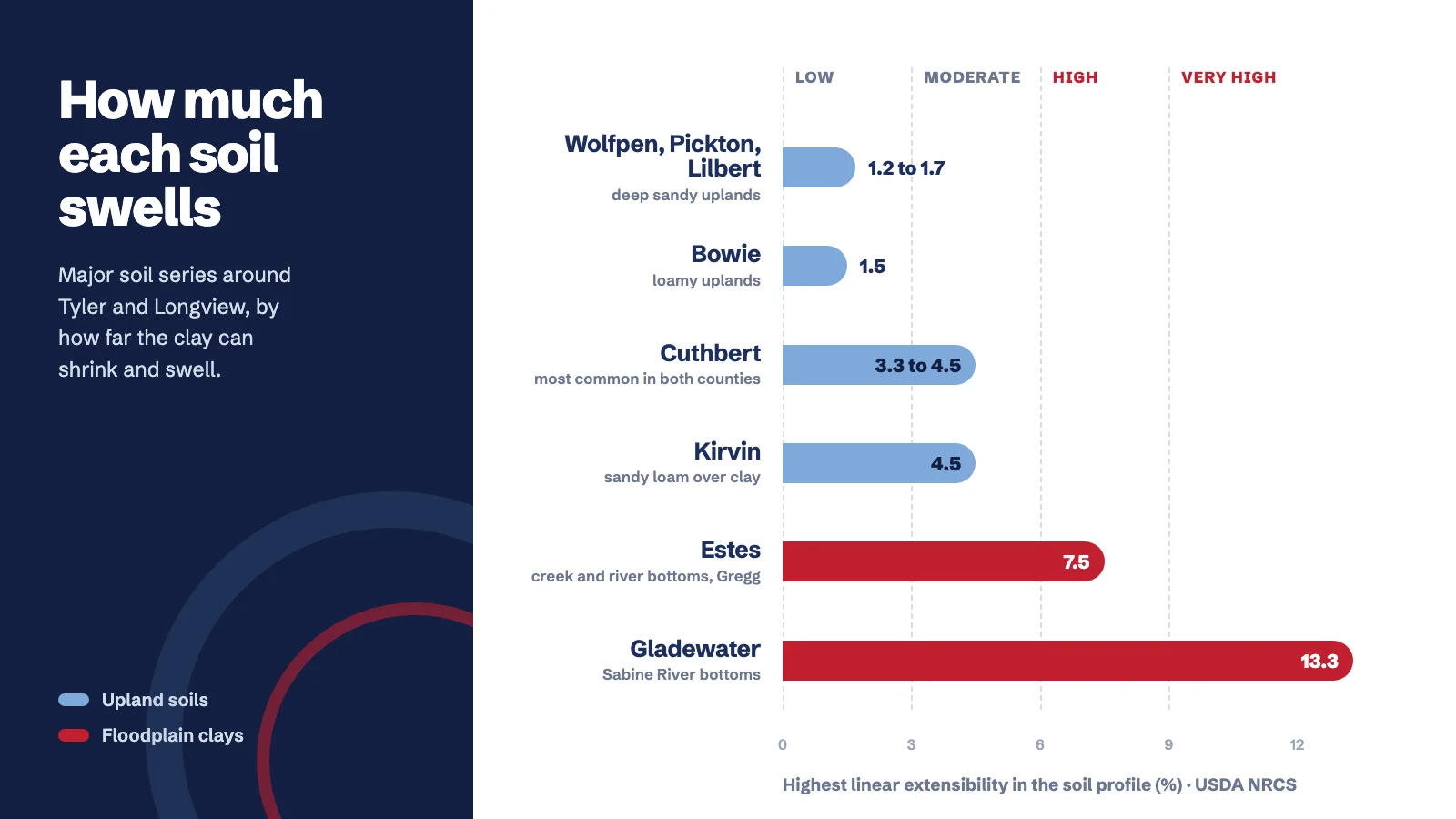
You'll hear that East Texas is all expansive clay. On the uplands, where most people live, the numbers say otherwise.
Where the ground really swells: creek and Sabine bottoms
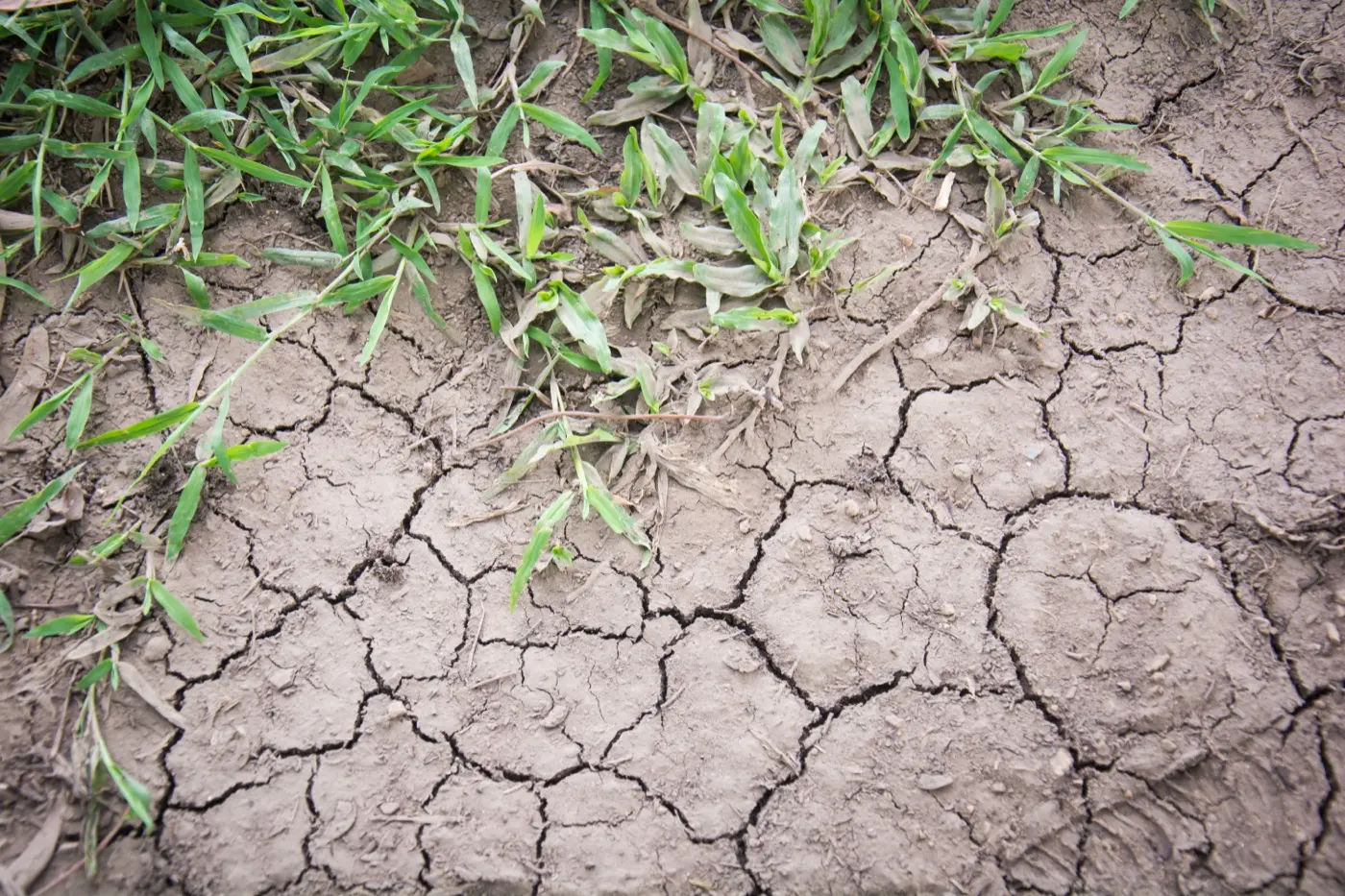
Gladewater clay is the soil of the broad Sabine River bottoms. Its official description says that when it dries, cracks a half inch to 2 inches wide open from the surface to more than 20 inches down. Estes, common along creeks in Gregg County, carries slickensides: shiny, grooved faces where the clay has sheared against itself through years of swelling and shrinking. Both flood. Estes is under water somewhere between 2 and 60 days a year in most years, mostly from November to May, and then it bakes in July.
Not many houses sit right on the floodplain. A lot more sit where the slope runs down to meet it. Picture a street in south Longview that drops toward a creek. The houses at the top are on sandy loam over moderate clay. Down near the bottom, the builder may have hit a different soil, or hauled in bottomland clay as fill to raise the lots. If the brick at the low end is cracked and the brick at the high end isn't, the soil change is a strong suspect, along with all the rain that runs downhill to those lots.
On that kind of lot, the water deserves as much attention as the floor readings. Ground that sits wet half the year and cracks open the other half needs the surface water carried away, and the drainage work usually comes before anything else.
The NRCS slab rating sounds worse than it is
NRCS scores every soil in Texas for a use it calls "Dwellings on Concrete Slab". Look it up for our two counties and you'll find about half of Smith County and about three-quarters of Gregg rated "very limited". That's the number some sales pitches quote.
Open the reasons. The rating counts acid soil, which is hard on concrete and steel. It counts steep slopes, wetness and flooding too. Strip it down to the soils where high shrink-swell is a listed limitation and the share falls to about 30 percent of Smith and about 38 percent of Gregg.
Even then the weight differs. On upland Cuthbert and Kirvin, NRCS gives shrink-swell a small weight in the score, about an eighth. On Gladewater it carries full weight, and on Estes nearly that. The data lines up with the table: moderate ground on the hills and the hard cases in the bottoms. When someone tells you every lot in East Texas is on highly expansive clay, they're giving you the version that sells piers.
Check the soil under your own lot in about ten minutes
The USDA's free Web Soil Survey covers both counties. All you need is the address.
- Open Web Soil Survey and start the app. Type the address into the search and zoom to your street.
- Draw a small area of interest around your lot. A few acres is plenty.
- Open the Soil Map tab. It lists each map unit inside your box, such as a Cuthbert or Bowie unit with a slope range.
- Under Soil Data Explorer, find Linear Extensibility in the soil properties and compare the number with the bands above.
- Under Suitabilities and Limitations, read the building site ratings, including the Texas slab rating if it's offered, and look at the reasons listed.
Keep the answer in proportion. These maps were drawn at county scale, so a lot near a boundary could be on either soil, and builders move a lot of dirt. Only a boring or an engineer's soil report tells you what's really under the slab. What the survey gives you is the likely story, and that's often enough to explain why a house on a sandy ridge has stayed put for forty years while one in the low corner of the same subdivision hasn't.
Wet-to-dry swings move a house more than any one dry year
Clay only moves when its water content changes, and the weather here changes it twice a year. A normal year brings about 42 inches of rain to Tyler and 45 to Longview. Spring is the wet stretch, with Tyler's wettest month in June at 4.38 inches and Longview's in May at 4.77. July is the driest in both, around 2.1 inches in Tyler and 2.5 in Longview, while highs sit at 94 to 95°F through July and August. Both cities average about 100 days a year at 90°F or hotter.
The clay at the slab edge feels all of that first. It gets the rain and the sun, while the soil under the middle of the house stays shaded and steadier, so the perimeter swells and shrinks more than the center.
The years people remember
Spring 2015 is a good example of the swing. March through May brought 28.62 inches of rain to Smith County, the wettest spring on NOAA's county records back to 1895 and more than double the normal. Gregg had 26.74 inches, its second wettest. Then August and September turned dry, under 3 inches in Smith and about 2 in Gregg. Clay that had been as full of water as it gets dried out hard within a few months, and local crews spent that summer resetting piers.
2011 was the other kind of hard year. Tyler got 24.97 inches of rain, its third-driest year on record, and 81 days at 100°F or above, when the old record was 47. Longview had 73. June through August was the hottest summer since 1895 in both counties. Oddly enough, the driest calendar year in both counties was 2005. It was 2011's heat, stacked on months of drought, that dried the clay along slab edges far deeper than usual.
Cold is different. On February 16, 2021, Tyler hit -6°F and Longview -5°F, the lowest either city has recorded. Frozen weather doesn't shrink clay. A pipe that split that week and ran for days into one patch of ground can swell it, though, so if a hose bib or sprinkler line burst at your house, keep an eye on that corner.
Sinking or rising: find out which before anyone prices a fix
From inside, a house that sank and a house that rose look alike. Doors rub, drywall cracks over the frames, and the floor feels like you're walking downhill to the kitchen. The fix is not alike at all. Piers hold up a part of the house that dropped, and they do nothing for a part being pushed up by wet clay.
On our soils the usual summer pattern is the slab edge dropping as the perimeter clay dries. The usual wet pattern is one high spot where water keeps getting in: under a dripping line, beside a sprinkler valve, in a bed that gets watered every evening. A floor survey shows which corner is high and which is low. Then you go looking outside for the reason.
Walk the outside of the house with that in mind and ask what's different about the low side or the high side:
- A big tree. Roots pull water from the clay on that side all summer, so it shrinks further, though a tree near the house isn't always the one to blame.
- One wet corner. A downspout, a low spot or a roof valley keeps that corner swollen while the rest dries.
- The west wall. Bare ground in front of a west-facing wall bakes far harder than a shaded north side.
- The slope. On a hillside lot the downhill side often sits on more fill and drains differently.
- A leak. A slab leak or a dripping AC condensate line wets one small patch every day of the year.
Most of that list is water you can control. Gutters that carry roof water out, ground that falls away from the brick, a sprinkler head turned off the wall and, in a long dry spell, steady watering around the slab all push the house toward even moisture. The clay will still move with the seasons, and a house can live with that when every side moves together. When the readings show more than seasonal breathing, the guide on how much movement is too much explains where engineers draw the line.
Look up your soil, then measure the house
Ten minutes in Web Soil Survey tells you what kind of ground you're on. It can't tell you what the house has done on it. That takes a level reading at a few dozen spots across the floors and a walk around the outside to see where the water goes.
When you want that done, call (903) 522-4592. We'll book a foundation inspection with a local specialist. Ask for the readings and a plain answer: seasonal movement, or something that needs work.
 Prefer our guides in Google results
Sabine Valley Foundation Repair is paid by the independent foundation specialists it introduces homeowners to. That never changes the advice we give. How we're paid