
Typical cost by type of repair
These are typical ranges for this part of Texas. Your price depends on the size of the house, how many piers it needs and what turns up once the work starts, so use them to plan, not as an estimate for your home.
| Repair | Typical cost | What it usually covers |
|---|---|---|
| Slab repair with piers | $5,000 to $15,000 | Piers along the side that sank, lifting the slab back toward level, a plumbing test before and after. |
| Price per pier, installed | $400 to $600 | Digging, driving the pier, the cap and shims, and backfill. Warranty terms vary by company, so ask what yours covers. Some quotes run to $1,200. |
| Pier and beam repair | $3,500 to $7,000 | New block piers or steel posts, re-shimming, sistered joists and a section of beam or sill plate. |
| Drainage instead of piers | about $5,000 | Regrading the yard and French drains on a bigger job. Gutters and downspout extensions cost far less. |
| Large or difficult jobs | $30,000 and up | Hillside lots, helical piers, many piers through the middle of the house. One hillside job was estimated at $45,000. |
Square footage barely enters into it. Piers go in along the part of the house that dropped, a few feet apart, so a big brick ranch with one sunken back corner can need fewer than a small house that sank at both ends and through the kitchen. Interior piers are the expensive ones, because getting a pier under a slab away from the edge means tunneling to it or cutting through the floor.
You can check a bid's pier line yourself. Take the drawing outside and pace off the low side, the stretch of wall where the cracks are and the doors bind. A drawing with piers along 60 feet of wall when your trouble sits in the last 20 deserves a question.
Estimate vs final bill: four examples
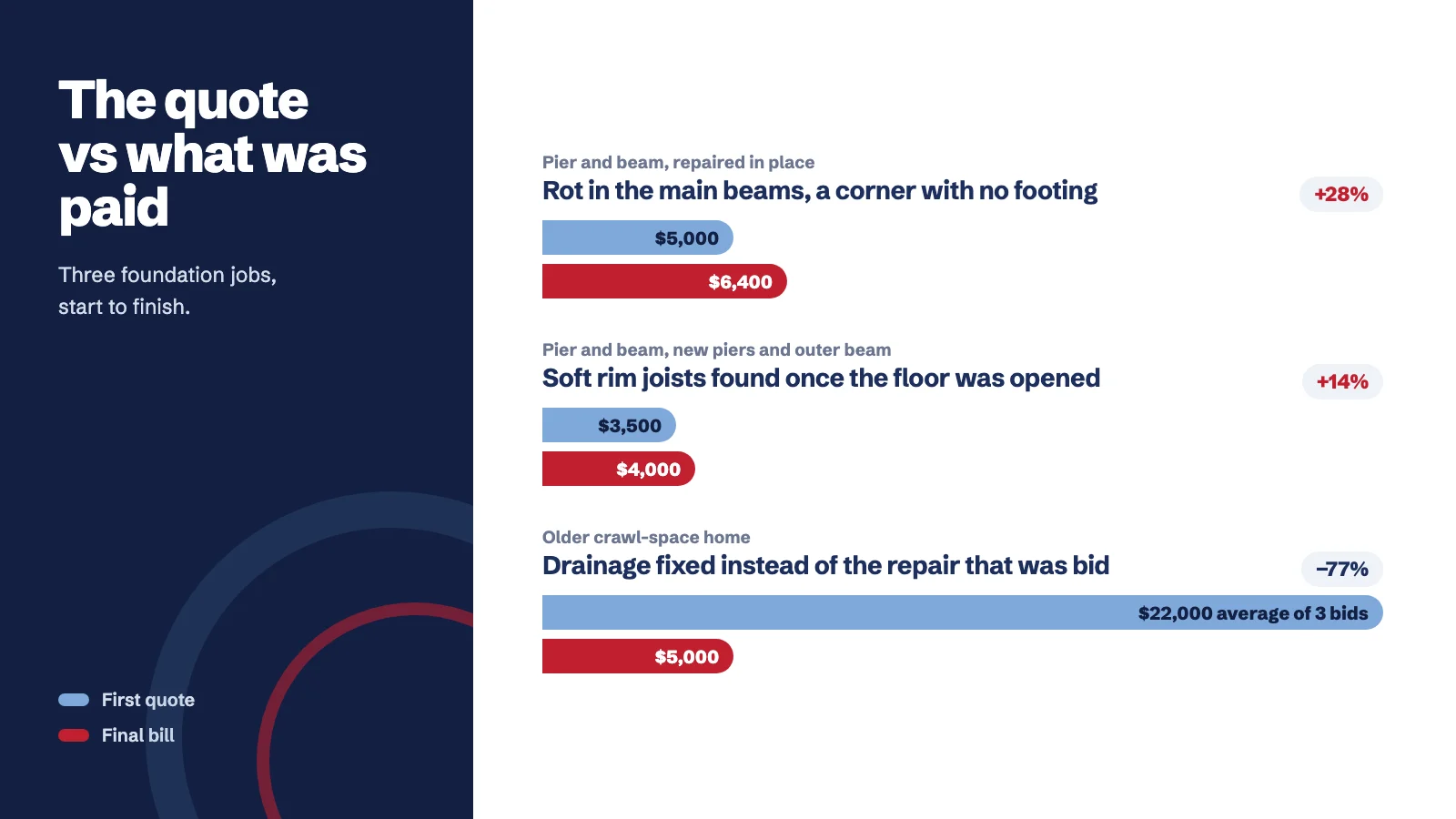
Nobody can see inside a beam until a jack is under it. On older pier and beam houses that one fact explains most of the distance between the first number and the last, and it isn't always a trick. Here are four examples of how a first quote and the final bill can drift apart, and why.
When the 20-ton jack went under it, a beam that looked fine from the outside crushed. Most of the house turned out to have little or no footing, and one back corner needed a hole more than 4 feet deep filled with concrete to carry a new pier.
The plan put the house on new piers and a new beam along the outside wall, so the old brick stem wall no longer carries weight. Dry rot turned up in the rim joists once the work started, and putting the siding back afterward was a separate price.
The owner regraded the yard and put in French drains instead. The crawl space dried out and stayed dry. Not every house gets away with this, but every house should be checked for it first.
The driveway and one end of the house were moving downhill. Helical piers screwed deep into firm soil were the fix, and the slope is what made it expensive.
Two cheap habits would have caught most of those surprises before anyone wrote a bid. Push a screwdriver into the beams and joists from the crawl space; where it sinks, keep probing until it hits hard wood. And at the worst corner, dig a small hole by hand against the brick to see how deep the concrete goes. Ten minutes with a trowel tells you whether there's a footing at all.
Why one pier costs hundreds when the concrete costs a few dollars
Most people who call about a pier price have already done the arithmetic. They've seen the pallets of concrete cylinders at a job down the street, or looked them up, and found a contractor pays about $3 apiece. A galvanized steel shim runs about a dollar. Then the quote says $500 a pier, and it feels like somebody is taking a cut.
What you pay for is the digging and the pressing. For each pier, a crew hand-digs a hole about 2 feet square beside the slab, deep enough to leave roughly 27 inches of room under the beam for a ram and a cylinder. They set the ram and push cylinders into the clay one after another until the ground pushes back harder than the house weighs. At that point the pile quits going down and the house starts to come up, which the trade calls refusal. On one lot it comes at 10 feet. Next door it might take twice as many cylinders, and nobody knows which until they're pressing.
Then comes the cap, the shims, the weight set back on the pile and the backfill. Twelve of those along the back of a house in August is a few days of hard labor before anyone counts the trucks, the permit, liability insurance, rain days with the crew on the clock, or a warranty the company has to honor long after your grass grows back.
Price pages written for the whole country often show per-pier figures several times ours. Most of them are pricing steel push piers or helical piers, which cost more and earn it on some lots. Around here, slab work is mostly pressed concrete. When a bid calls for steel, ask what about your lot needs it; steel vs concrete piers covers where each one fits.
What pushes the price up
- More piers. The biggest single driver. One dropped corner might take four or five, while a house that went down at both ends needs a line of them.
- Piers inside the house. Tunneling under the slab from outside leaves your floors alone and is all shovel work, so it costs more up front. Breaking out the floor looks cheaper until tile, hardwood or a brick entry has to go back in.
- Depth. Each pier goes down until refusal. Soft, deep clay can swallow many more cylinders than the bid assumed, so ask how the contract handles a pier that runs deeper than priced.
- Rotten wood. Dry rot in beams, joists and the sill plate is the usual reason a pier and beam repair grows after the crew is underneath.
- Missing footings. Lots of older houses have little or no concrete under the brick stem wall, and new footings mean more digging and more concrete.
- Plumbing. A static test before the lift can turn up a leak that has to be fixed first, and lifting can pull apart old joints in pipes set in the slab.
- Access. Decks, patios, a tight crawl space, a slab addition or a driveway in the way all add hours.
One way to bring the price down is fine as long as you know what you bought. Piering only the side that dropped costs less than going around the whole house. Texas engineers' own repair guidelines say plainly that underpinning one part of a foundation does nothing for the parts left alone. A bid that covers the back wall gets you a warranty on the back wall. Get that written on the contract so nobody acts surprised when the front starts moving after a dry summer.
When water is the cheaper fix
Before anyone counts piers, follow the water. Clay moves a house when one side stays wetter or drier than the rest. The upland soils in Smith and Gregg counties are sandy loam over a clay subsoil with moderate shrink-swell, and the floodplain clays near the Sabine swell much harder. Either way, the cause is usually on the surface where you can see it.
Say the cracks are all at the back left corner. Stand there after a hard rain. When the downspout empties into the flower bed against the slab and the ground tilts toward the brick, that corner has spent years swinging between soaked and baked. The building code asks new lots to fall 6 inches in the first 10 feet away from the house. A lot of older yards in town never had that, and a few loads of dirt, a regrade and longer downspout runs cost a fraction of a pier line.
Fix the water and the movement often slows or stops. Once it's under control, most of the settling still to come tends to happen within about two years. Sometimes the honest plan is drainage now, a second set of readings in six months, and piers only if the numbers keep moving. Foundation drainage covers what that work looks like.
When a big quote needs a second look
Most houses that call about foundation trouble are a 3 or 4 on a 10-point scale. A quote of $30,000 to $50,000 says yours is a 9. It might be. Before signing, we'd check three things, in this order.
Was it built that way?
A tape measure answers more than a level here. Measure floor to ceiling at both ends of the low room. At 96 inches on one end and 97 1/2 on the other, the framers built square walls on a slab that was already out of level. A house that sank after it was built takes the ceiling down with the floor. Brick courses that read dead level under a 4-foot level point the same way. How much foundation movement is too much goes deeper into telling the two apart.
Did it sink, or did it rise?
Piers fix a house that went down. If the middle of the slab came up because wet clay pushed it, often from a leak, a ring of piers around the edge doesn't touch the problem and can lock in the hump. That job starts with finding the water.
Are the bids pricing the same job?
Bids with 8, 14 and 25 piers aren't three prices for one repair. When they won't agree, an engineer's plan with pier locations gives every company the same job to price, and whether you need a structural engineer depends mostly on how far apart they are.
Costs beyond the repair
The foundation contract covers the foundation. Lifting a house moves everything attached to it, so budget a little time and money for the rest.
- Drywall, paint and trim. Some cracks close as the house comes up and new ones open. Wait a few weeks to a few months before patching.
- Doors and tile. Doors usually need adjusting. Grout can crack, and caulk joints like the tub to the floor can split.
- Plumbing. Any leak the first test turns up, plus a second test after the lift.
- Outside. Brick repointing, siding taken off and put back, gutters knocked loose, and patches in the driveway or garage that will look patched for a few years.
- The roof. Check the rubber boots around the vent pipes after a lift. They can pull up and leak, and the foundation crew won't climb up to look.
- Backfill and the yard. Ask whether filling the holes is in the price. Too little dirt lets water pond at the slab; too much buries the weep holes in the brick.
Insurance, liens and when to pay
Texas homeowner policies almost never pay for settling, shrinking clay or general earth movement. Water from inside the house is the exception people miss. Damage from a sudden plumbing leak can be covered, and some policies carry a foundation endorsement for slab damage caused by leaks, usually capped at a share of your dwelling coverage. Read your declarations page and what Texas policies cover on foundations before you call your agent.
For a house under about 10 years old, the first call goes to the builder or the warranty company. Many newer homes carry a 10-year structural warranty through the builder's contract, and a deductible is a lot less than a pier line.
Texas law gives you a protection most people never use. Before you sign a repair contract, the contractor owes you a written disclosure statement about liens. It tells you to hold back 10 percent of what you pay until 30 days after the work is finished, and to get an affidavit that all bills are paid before the final check. Should the company skip paying its concrete supplier, that supplier can put a lien on your house, and the money you held back is your cushion. Choosing a foundation company covers the rest of the paperwork.
Financing is common in this trade, so ask. Waiting for a better month rarely helps, though. A summer like 2011 can turn one dropped corner into two, and the cracks inside keep growing in the meantime.
Put a number on your own house
The table above tells you whether a quote is in the right neighborhood. It can't tell you how many piers your back wall needs, or whether it needs any. That takes a set of floor readings and somebody walking the outside after a rain.
Call us at (903) 522-4592 while the quote is still sitting on the counter, before any discount deadline runs out. Tell us what you've noticed and we'll book a local specialist to measure every room and write down the plan and the price. Keep the first quote handy for the visit; a second set of readings is the fastest way to learn whether it fits the house.
Rather type it out? The request form works too.
 Prefer our guides in Google results
Sabine Valley Foundation Repair is paid by the independent foundation specialists it introduces homeowners to. That never changes the advice we give. How we're paid