Almost every house cracks, and most of it isn't movement
People usually find the first crack by accident. You pull the car in and notice a line wandering across the garage floor, or you're painting the hall and there's a crack climbing off the corner of the bathroom door. Then you search it, and every result is about bowing basement walls.
Concrete shrinks as it dries, and a slab the size of a house will crack somewhere while it cures. Builders saw control joints to tell those cracks where to go; plenty of slabs crack a foot away from the joint anyway. Brick and concrete grow and shrink a little with the heat. Drywall cracks where the tape was thin, or where the framing dried out in the house's first few summers.
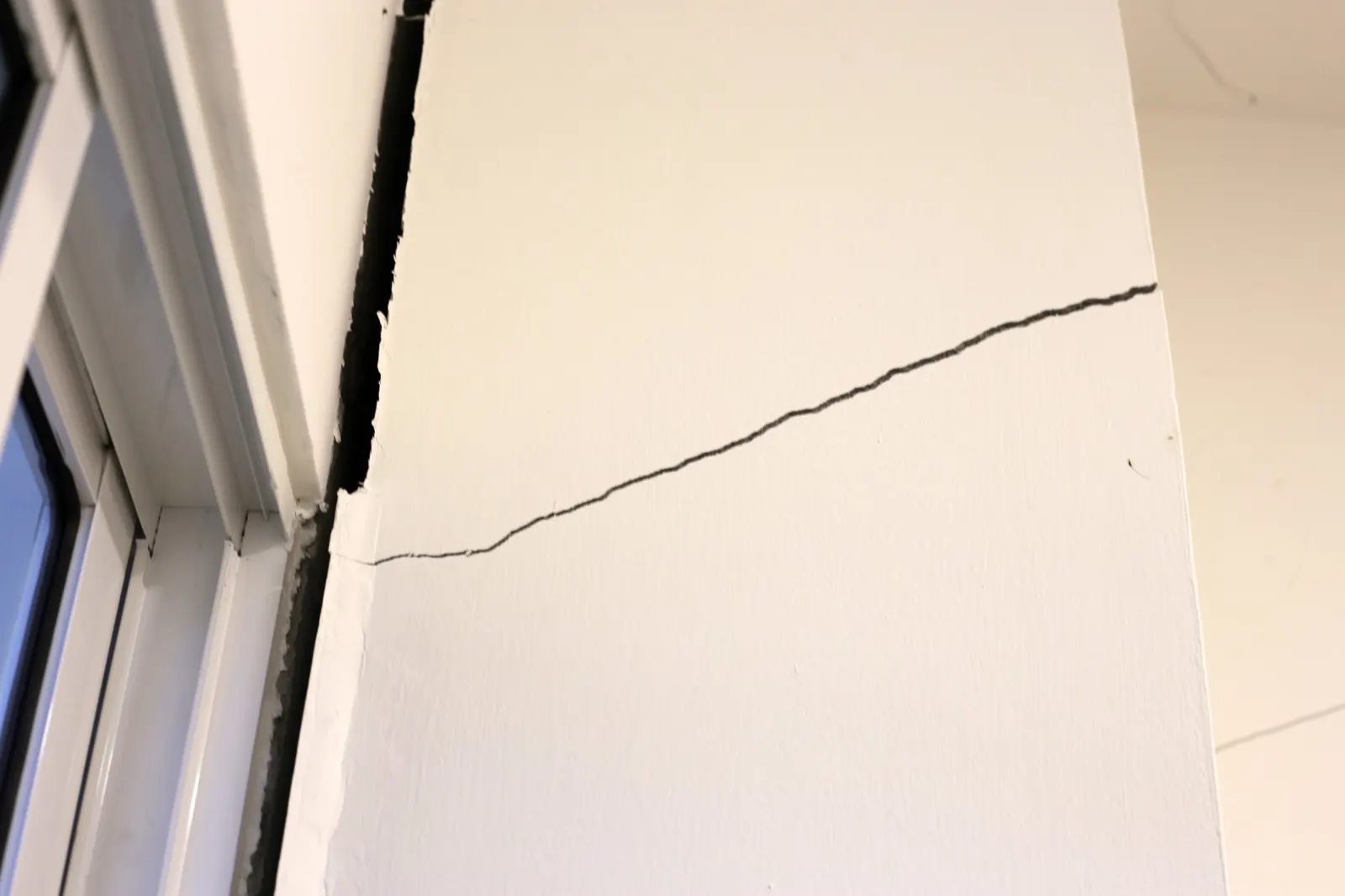
So any house has three kinds of crack: shrinkage, heat and real foundation movement. Only the last one is your problem. Length won't tell you which is which. A six-foot hairline across the garage can be nothing at all, while a crack two bricks long where one side has pushed out past the other is a real sign.
Foundation crack types and what each one usually means
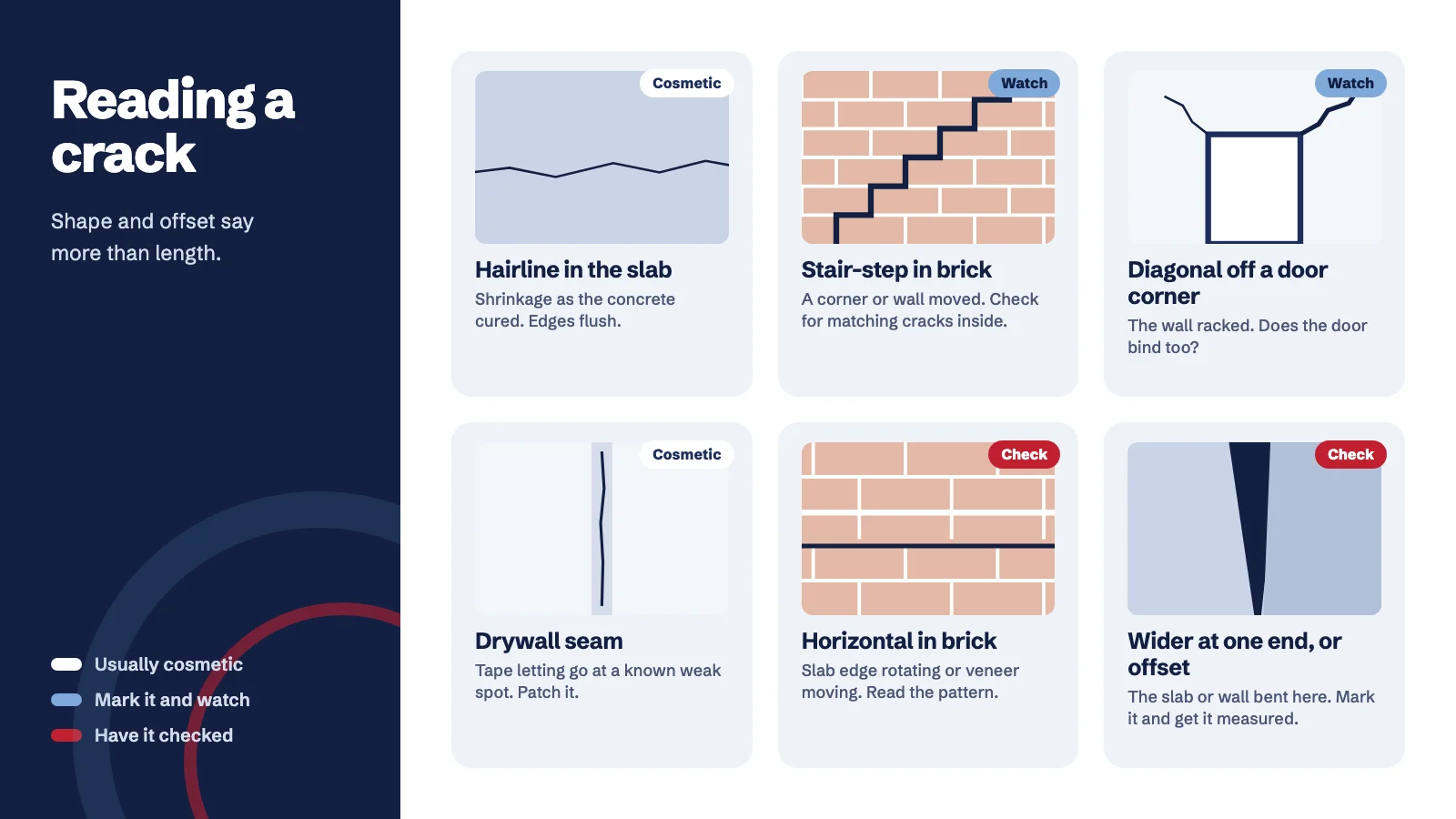
Here is how the common cracks on East Texas slab and pier and beam houses tend to read. Use it as a first pass; what's around the crack, and how it behaves over a season, count just as much.
| Crack | Usually means | What to do |
|---|---|---|
| Hairline cracks in a slab or garage floor, edges flush | Shrinkage as the concrete cured, often near a control joint. | Nothing, or seal it to keep water out. |
| Vertical crack in the slab edge, even width | Shrinkage or a small seasonal flex. | Mark the ends and date it. |
| Vertical crack wider at the top or the bottom | The slab bent there. Wider at the top: the ends dropped. Wider at the bottom: the middle dropped or the ends rose. | Mark it, and have it checked if it grows. |
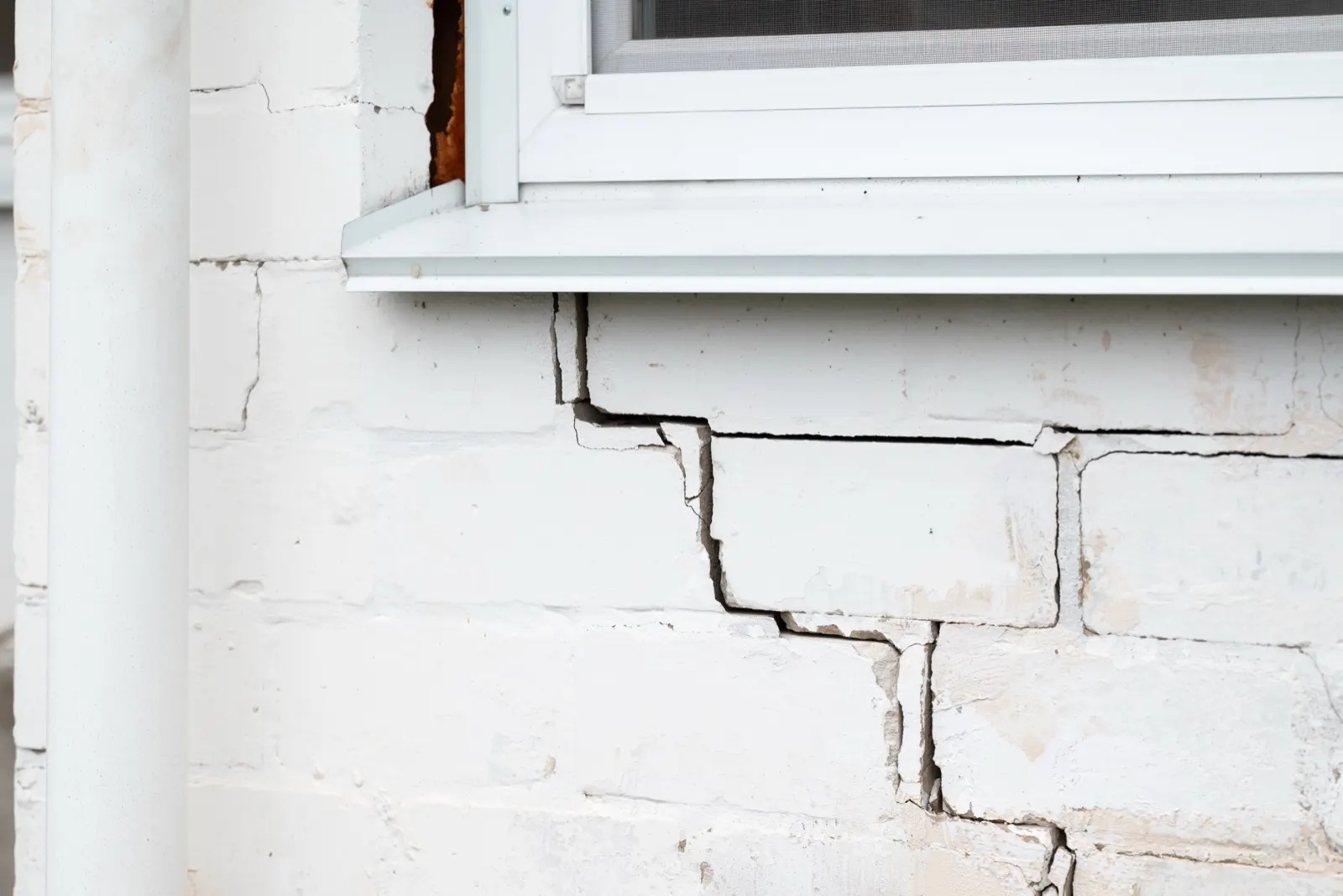
| Stair-step crack in brick mortar | The corner or wall below it moved. Common at corners and above windows. | Look for offset and a matching crack inside. |
| Straight vertical crack a short way from a brick corner | Often the brick itself growing, with no expansion joint to take it. | Watch it. Check the slab before blaming it. |
| Diagonal crack from a door or window corner | The wall racked, and the corner of the opening is where it gave. | Check whether the door also binds. |
| Horizontal crack in brick | The slab edge rotated, or the veneer moved on its own. | Have the pattern around it read. |
| Crack along a drywall seam or rounded corner bead | Tape and mud letting go at a known weak spot. | Patch it. Cosmetic on its own. |
Horizontal cracks get the scariest write-ups online, because most crack articles come from basement country. In a basement a horizontal crack means the soil outside is shoving the wall inward. We hardly have basements here. On a slab or pier and beam house the horizontal crack is in brick veneer, and it means something else entirely.
Brick, drywall and slab crack for different reasons
Brick grows, and it never shrinks back
Fired clay brick is smallest the day it leaves the kiln. From then on it soaks up moisture from the air and gets slightly bigger, and the Brick Industry Association's technical notes say it's the only common building material whose moisture growth is permanent. On a long wall, all that growth piles up toward the corners. With no expansion joint to take it, the brick cracks near the corner, usually straight up a vertical joint a brick or two from the edge.
That crack gets blamed on the foundation all the time. Settlement looks different: stair-steps running up from a corner or a window, cracks that open wider toward the top, bricks shoved out of line. Brick veneer sits on the edge of the slab, which makes it the clearest record of what the slab edge has done. It just keeps a little diary of its own as well.
Drywall shows movement first
Inside, the same movement looks worse. The guideline most Texas engineers use for foundation movement puts the point where a crack becomes noticeable at about 0.02 inch in drywall, half the 0.04 inch it gives for brick and concrete. So a corner that shifted a hair can leave a clear line over the bedroom door and nothing you'd spot outside.
What tells you it's movement is company. A drywall crack that lines up with a brick crack outside, with a door that binds nearby, or with a gap under the baseboard belongs to a pattern. Old plaster in pre-war houses cracks more freely than drywall, so read it more loosely.
The slab tells you with your foot
You see slab cracks in the garage, on the patio, and under flooring when it comes up for a remodel. Most are shrinkage. Run a bare foot or a fingernail across one. Flush on both sides is old news. A lip you can catch from one side but not the other means the slab has moved at that line, and if it runs straight across a room and carries through tile, it's worth a proper look.
Offset and taper tell you more than length
Stand at the crack and work through it in this order.
- Are the two sides still in line? Lay a straightedge or a credit card across it. If one side has moved up, down or out from the other, the crack has offset. Offset is the strongest sign of movement you can see without tools.
- Is it the same width end to end? An even crack is usually shrinkage or heat. One that tapers, wide at one end and closed at the other, is a hinge, and the wall or slab bent there.
- Is it alone? A crack with a sticking door, a gap at the trim and a crack on the same corner outside is part of a pattern. One with nothing around it usually isn't.
Taper also points a direction. On a wall, a crack wider at the top usually means the ends of that wall dropped compared with the middle. Wider at the bottom usually means the middle dropped, or the ends were pushed up. It's a rough read, and a specialist confirms it with floor readings across the whole house, but it's the same reasoning they start from.
Track a crack through a summer and a winter
One look at a crack tells you its shape. Six months tells you what it's doing. On East Texas clay that matters, because cracks open in a dry August and close back up in a wet spring, and you want to know whether yours cycles or ratchets.
- Pencil and date the ends
Draw a short line across each tip and write the date. On brick, use a marker or a strip of painter's tape at each end.
- Measure the widest point
A ruler with fine marks, a feeler gauge or a printed crack card. Write the width beside the date.
- Photograph it the same way every time
Same spot, same distance, a coin or tape in the shot.
- Check monthly, and after big weather
A long dry spell, a week of heavy rain, or a hard freeze like February 2021, when Tyler hit -6°F, are when movement shows.
- Read the trend
Opened in summer and closed by spring: seasonal. Opened in summer, stayed open, opened again the next summer: ratcheting, and worth an inspection.
Sealing a crack and fixing the movement are two different jobs
Search for crack repair and you'll get kits: epoxy and polyurethane injection, caulks, patching compounds. They work for what they're made for. Most injection kits were designed for poured basement walls, where a crack leaks water and sealing it is the whole job. On a slab or pier and beam house, the cracks you can reach with a kit are mostly in the garage floor or a patio, and those are nearly always cosmetic.
The crack is even, flush, and hasn't moved past your marks in a few months. Seal garage and patio cracks to keep water out, repoint loose mortar, tape and mud the drywall.
The crack is growing, offset or tapered, or came with doors and floors that changed. The house is still moving, and a filled crack just opens again beside the patch.
One common mistake: a crack gets caulked, painted or injected before anyone has measured it. Now the record is gone, and the next person to look can't tell whether it grew. Mark it, date it and photograph it before you touch it.
Newer houses add one more caution. A lot of slabs in newer subdivisions are post-tensioned, with steel cables running through the concrete under heavy tension. Some have a stamp in the garage floor saying not to cut or core the slab, but not all of them do. Never drill into a slab to pin or staple a crack until you know what's inside it.
Fixing movement means fixing whatever moved the house. That's the water first, then supports if the readings call for them: piers under a slab pushed to firm soil, or new supports and shims under a pier and beam floor. After any lift, wait a few weeks to a few months before patching, because some cracks close and a few new ones open as the frame settles. Each level of repair carries a very different foundation repair cost.
When a crack is worth a specialist's visit
Have it looked at when it passes your marks within a few months, when one side has shifted out of line with the other, when it's wider at one end and you can see daylight or slip a coin in, or when it arrived with doors, trim or floors that changed in the same part of the house. A crack that shows up quickly after a plumbing leak or alongside a jump in the water bill should be seen soon.
Don't settle for a visit that stops at the crack. A proper foundation inspection walks the outside, matches inside cracks to outside ones and takes floor readings, so the crack gets read against the whole house. Expect a straight answer if it's cosmetic. Plenty of the cracks people call about are, especially when none of the other signs of foundation problems show up with them.
Send us the crack, the dates and the photos
If you've been marking a crack for a while, you already have the most useful thing a specialist can get on a first visit: proof of what it's doing over time.
Call (903) 522-4592 and read us the dates and widths off the wall. If the marks say it's still opening, a local specialist can come out to take floor readings and check them against your record, and you can hand over the photos when they arrive. Stuck at work all day? The request form gets you a callback.
 Prefer our guides in Google results
Sabine Valley Foundation Repair is paid by the independent foundation specialists it introduces homeowners to. That never changes the advice we give. How we're paid