

An hour of homework before anyone comes out
A homeowner who knows the house is the hardest one to oversell. You need a pencil, a marble, a flashlight and a screwdriver.
- Pencil the cracks. Draw a short line across each end and write the date beside it. In a month you'll know which ones are growing, and so will whoever bids.
- Write down when things changed. The bedroom door that started catching last August, the tile that cracked after the 2021 freeze. Change over time tells more than the size of any crack.
- Roll a marble. Set it on a hard floor in each room and watch where it goes. It measures nothing, but it tells the specialist where to start.
- Go under the house. On pier and beam homes, take the flashlight and screwdriver into the crawl space and push the blade into beams and joists. Where it sinks, there's rot, and rot is what makes those bills grow. Wear gloves and a mask, switch off power to any wiring near the access, and watch for snakes, spiders and standing water. If it's tight or flooded, stay out.
- Walk outside in the rain. Look for water standing at the slab, a downspout emptying at a corner, a sprinkler head soaking the brick.
- Find the paperwork. An old inspection, plumber's invoices, and any warranty from an earlier repair. Piers already under the house may still be covered by the company that put them there.
Six questions that sort foundation companies quickly
Ask every company the same ones and write the answers on each bid. A vague answer counts as an answer.
- What moved, and what in the house tells you so? Someone who points to the brick, the doors and the readings is diagnosing. Someone who points to the brochure is selling.
- Did it sink, or did part of it rise? Piers fix sinking. A company that can't say how it told the difference hasn't looked hard enough.
- Could some of this slope be how the house was built? Lots of slabs were poured an inch or more out of level and haven't moved since. A good specialist says so even when it shrinks the job. They tell by measuring how much the floor has actually moved, not just how far it slopes.
- Where does each pier go, and how do you decide when it's deep enough? You want a drawing, a straight answer about refusal or target pressure, and a promise to set the house's weight back on each pier after it's capped so it can't spring up.
- What isn't in this price? Backfill, drywall, siding, rot found later, plumbing repairs, the floor over a breakout. The exclusions are the real price.
- Who pays to get back to a pier if it ever needs adjusting? Re-tunneling or breaking out a finished floor costs real money. A warranty that covers the pier but not the digging covers less than it sounds.
Ask the routine ones too: how long they've worked in this area, who pulls the permit and calls 811, whether they test the plumbing before and after, and how many days the crew will be there.
Three bids, lined up side by side
Three bids on one house can come back with 3 piers, 10, and 20 around the whole slab, which means three different opinions about what the job is. Read them the way a diagnostician would. When two put piers along the same back wall and the third rings the house, the two that agree have probably found the problem, and the third is pricing protection against everything else. When all three disagree, stop collecting bids and get an independent plan.
| Line on the bid | What to look for |
|---|---|
| Cause named | A specific cause backed by the readings, not "your foundation is failing". |
| Pier count and locations | A drawing that shows where each pier goes. Exterior only, or interior too? |
| Pier type and depth | Pressed concrete, steel push or helical, and how the crew decides when a pier is deep enough. |
| Interior access | Tunnels or breakouts, and who pays to put floors and tile back. |
| Plumbing | A static test before and after the lift, and what happens if it fails. |
| Drainage work | Gutters, regrading or drains: included, only recommended, or left out. |
| Permit and 811 | Named in writing as the contractor's job. |
| Warranty | Length, what it covers, who pays to re-access piers, and whether it transfers. |
| Exclusions | Backfill, drywall, paint, siding, rot found later, plumbing repairs. |
| Timeline and cleanup | Days on site, where the dirt goes, how the yard is left. |
Fill this in for each bid before you look at the totals.
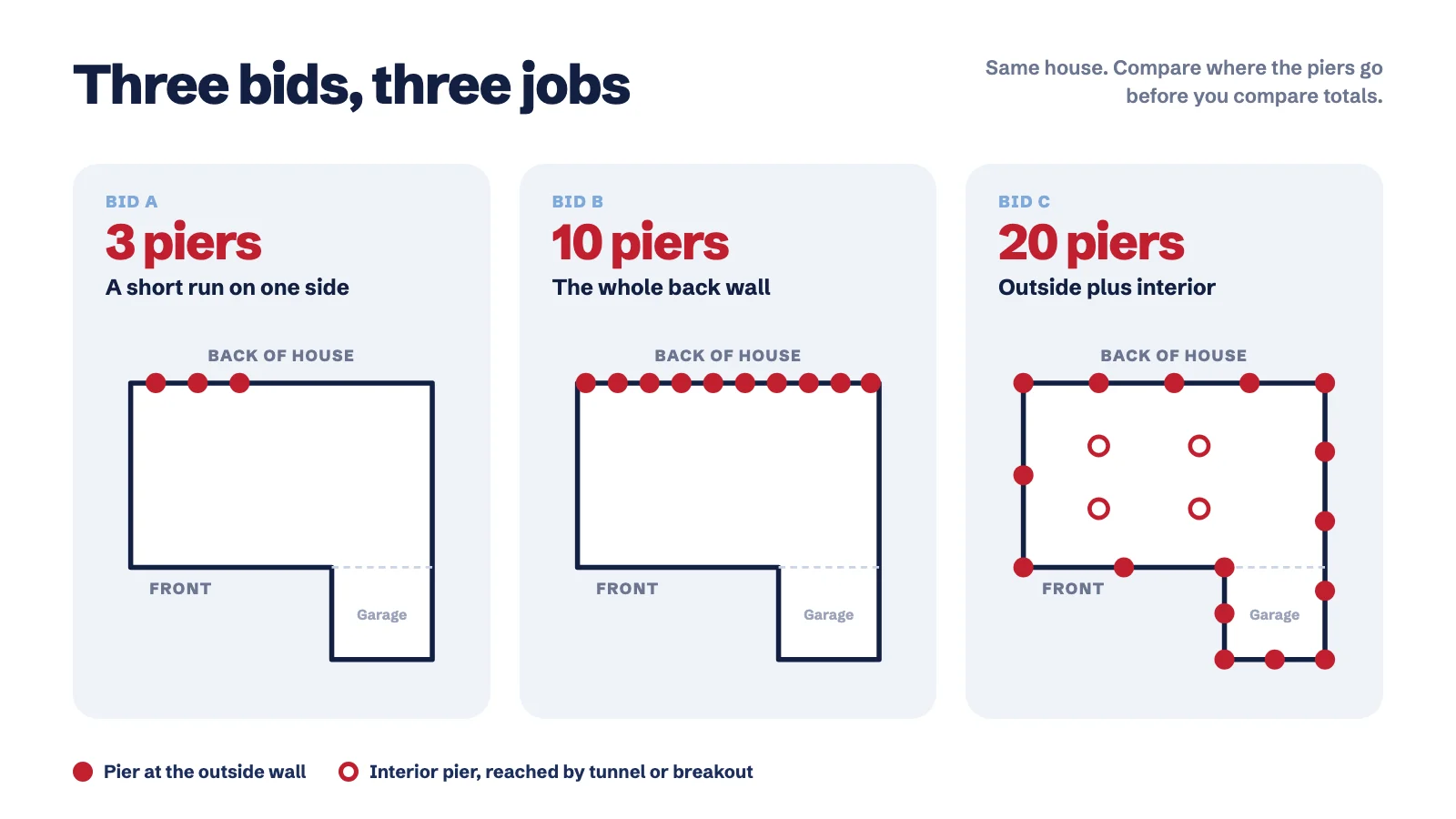
Only once the scopes match does the total mean much. Set it against typical foundation repair prices in East Texas, and when the bids refuse to line up, an engineer's plan with pier locations gives everyone the same job to price. Whether you need a structural engineer mostly comes down to how far apart the bids are.
A free inspection is a sales visit, and that's fine
Most foundation companies come out at no charge. Be clear about what that visit is. The person with the level works for a company that sells piers, often on commission, and plenty of people in this trade learned it from pier suppliers, whose training has a way of finding work for the product.
None of that makes the visit worthless. A careful specialist reads every room, explains the numbers and now and then tells you the house doesn't need piers at all. Treat the free visit as an informed bid. An engineer's report, which you pay for and which comes with nothing to sell, is the referee.
One question sorts salespeople fast. Ask what you could do yourself to slow the movement down. A company that talks about gutters, grading and watering before it talks about piers is thinking about your house.
Red flags in a foundation repair bid
- The scary number. "You're an inch and a half off, it's going to fall apart." A number with no history behind it proves nothing about movement.
- Every house needs piers. If "fix the drainage and watch it" never comes up, the company sells one product.
- Piers for a slab that rose. When the middle heaved from a leak or wet clay, piers around the edge won't fix it.
- Sign today. A discount that dies when the salesperson leaves. In Texas, a contract you sign at home after a company's pitch can usually be canceled until midnight of the third business day, and the seller is supposed to hand you a cancellation notice with it. A house that took years to move can wait a week for two more bids.
- One day for a big job. A slab job with many piers usually takes a few days. Speed on a big job means short piers.
- Most of the money up front, or cash only. Payments should follow the work.
- No permit and no plumbing test. "We don't need one for this" in a city whose code calls for one, and a crew that lifts a slab without testing the lines it might pull apart.
The contract, the payments and the warranty
Read the contract at your own table, not on the tailgate of a truck. Texas property law requires the contractor to hand you a lien disclosure before you sign anything for a repair to your house. Read it. It advises keeping back a tenth of each payment until 30 days after the job wraps up, and asking for a bills-paid affidavit, a sworn statement that everyone who supplied or worked on the job has been paid, before the last check. That reserve is what stands between you and a lien from a concrete yard you never dealt with.
Tie the other payments to the work. A modest deposit, then payments as stages are done, and never the bulk of it up front.
A lifetime warranty lasts exactly as long as the company. Ask how many years this one has been standing behind piers, whether the warranty transfers when you sell, and what a transfer takes; some want paperwork filed and a fee paid within a set time after closing. Ask what voids it, too. The usual answer is drainage work you were told to do and didn't. Keep the original with your deed, and remember it covers the piers that company installed and nothing else.
Ask for the pier log as well. A good crew writes down how deep each pier went and the pressure it reached. One pier that stopped at 6 feet next to one that went 20 is worth a question while the crew is still in your yard.
Choosing well the first time matters more here than in most trades. When a repair fails, the old piers sit in the spots where new ones would go, and the next company has to work around them.
Texas has no state license for foundation contractors
Bills to create one failed in 2011 and 2013, and the state agency that once registered home builders was abolished in 2009. Anybody with a truck can paint "foundation repair" on the door, so the word "licensed" on a truck tells you little. Here's what you can check.
- City registration. Tyler and Longview both register contractors, and Longview asks a residential contractor to post a bond and holds them answerable for foundations. A call to the permit office in Tyler or Longview is the quickest way to ask about a company.
- Insurance. Ask for a certificate of liability insurance and look at the dates. If someone gets hurt digging beside your house, you want that covered.
- The engineer, if there is one. Engineers are licensed in Texas. Look any engineer up on the state engineering board's license roster, where only an "Active" license counts.
- Who sent the engineer. If the repair company brought one along, ask whether the company is paying for this visit. State rules don't let an engineer take pay from two sides of the same job, and a conflict has to be put to you in writing.
- Reviews with some age on them. Five stars from install week tell you the crew was polite. Look for customers writing two or three summers later, and read how the company answered complaints.
Permits and 811 are the contractor's job
Both cities build to codes that require a permit to repair a building. Neither publishes a separate rule just for foundation work, so the contractor should confirm with the city and pull the permit before the first hole. In Tyler that runs through Development Services at (903) 531-1151 and the city's eTRAKiT permit portal, and in Longview through Building Inspection at 903-237-1074. Outside city limits there's usually no county permit for a repair, though floodplain, septic or HOA rules can still apply.
State law also requires a call to 811 at least 48 hours ahead, weekends and holidays not counted, and no more than 14 days before powered digging 16 inches or deeper. Pier holes go deeper than that, and homeowners get no exception. The company doing the digging should place the ticket.
Keep in mind that 811 marks the utility company's lines, not yours. Your sewer line to the street, sprinkler lines and any private gas or water line won't be marked, so walk the crew around and show them where those run. What to expect during foundation repair follows the job from that walk to the cleanup.
Start with one bid you can measure the others against
Two strangers' bids are hard to judge against each other. A third one with readings on paper, a pier drawing and a named cause gives you a yardstick for both, and it's worth having before anyone pushes you to sign.
Call (903) 522-4592 and tell us what the other companies proposed. A local specialist can come out for a visit, so have your pencil marks, your notes and the other bids out on the table. Asking the six questions above takes about ten minutes, and the answers will tell you more than the totals do. If calling isn't handy, the inspection request form reaches the same people.
 Prefer our guides in Google results
Sabine Valley Foundation Repair is paid by the independent foundation specialists it introduces homeowners to. That never changes the advice we give. How we're paid